
West Virginia lawmakers mulling improvements to foster care, child welfare
House Health Committee Minority Chairman Mike Pushkin supports strengthening the Foster Care Ombudsman office. (Photo courtesy of WV Legislative Photography)
Del. Jonathan Pinson believes a bill that would create a new communications platform for foster families will help connect them to more resources and assistance. (Photo courtesy of WV Legislative Photography)
House Health Committee Chairwoman Amy Summers believes the state’s Foster Care Ombudsman needs greater authority and autonomy. (Photo courtesy of WV Legislative Photography)
House Health Committee Minority Chairman Mike Pushkin supports strengthening the Foster Care Ombudsman office. (Photo courtesy of WV Legislative Photography)
Del. Jonathan Pinson believes a bill that would create a new communications platform for foster families will help connect them to more resources and assistance. (Photo courtesy of WV Legislative Photography)
House Health Committee Chairwoman Amy Summers believes the state’s Foster Care Ombudsman needs greater authority and autonomy. (Photo courtesy of WV Legislative Photography)
Trending
CHARLESTON -- While lawmakers in the West Virginia Legislature look at reforming and splitting up the state Department of Health and Human Resources, bills reforming the state' foster and child welfare systems are moving through.
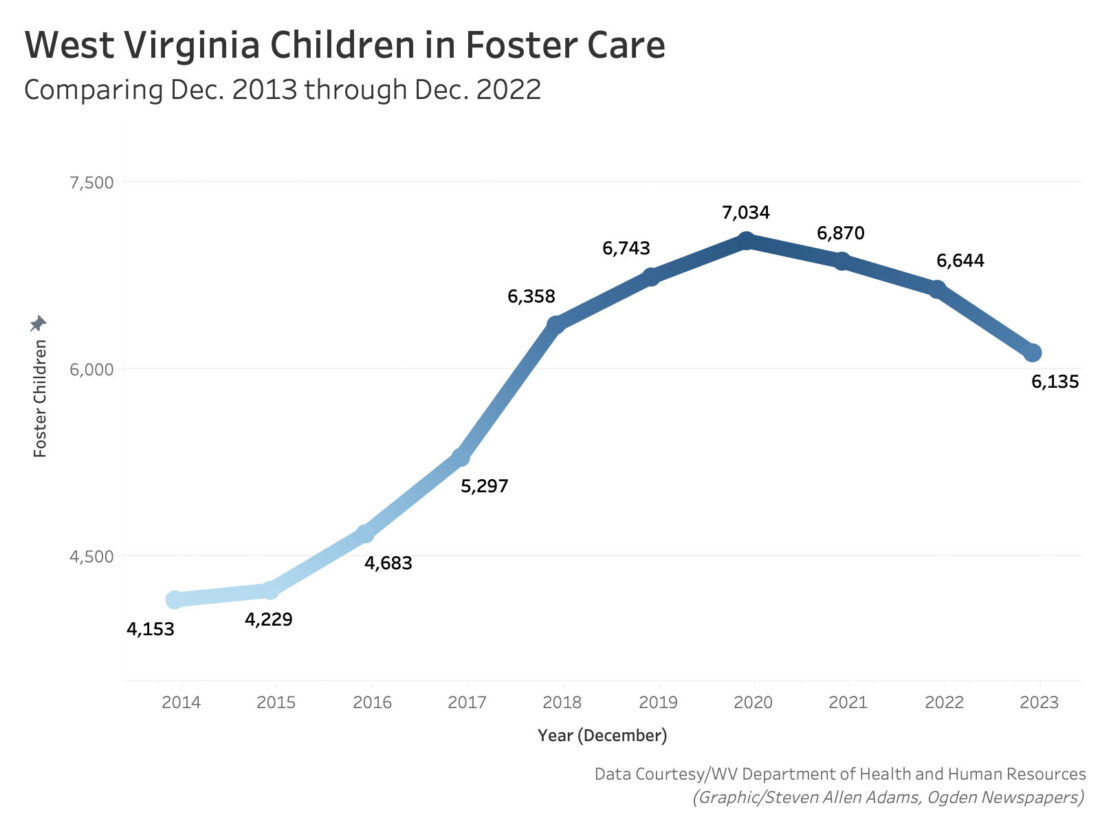
According to DHHR, there are 6,151 children in foster care in West Virginia as of Jan. 12. That's a 17% decrease from 7,441 children in foster care as of April 2020 -- one month after the COVID-19 pandemic hit, sending the state's unemployment rate soaring to 15.5% and a year that saw a record-breaking 1,336 fatal drug overdose deaths.
Despite the numbers of children in foster care coming down, the numbers remain high compared to a decade ago, spiking by 47% from 4,153 children in foster care in December 2013 to 6,135 foster children as of the end of this past year.
"We're dealing with a real crisis here in West Virginia," said Del. Jonathan Pinson, R-Mason, during a committee meeting Friday. "West Virginia leads the nation per capita in children that are in foster care. If you take all of the children in foster care and you were to put them in one area with one zip code, it would be the 22nd largest city in West Virginia."
West Virginia's judicial system has also been swamped by an increase in child abuse and neglect cases. In 2012, the state's circuit courts hear 3,561 abuse and neglect cases. That number jumped to 5,867 cases as of 2021 - a 65% increase over a 10-year period.
Adding to these issues is the fact that DHHR does not have the personnel to handle the increase in foster children or abuse and neglect investigation. According to DHHR's Child Welfare Dashboard, only 67% of Child Protective Service (CPS) worker positions are filled, while only 64% of Youth Services (YS) worker positions are filled.
Fifth Circuit Judge Anita Harold Ashley, president of the West Virginia Judicial Association, wrote a letter to House Speaker Roger Hanshaw, R-Clay, offering her organization's assistance in solving these issues. Ashley said the increase in foster placements and abuse and neglect cases, combined with the severe vacancy numbers within the Bureau of Social Services, is pushing the judicial system past the point of no return.
"These … facts place immense pressure on the judicial system's ability to resolve juvenile cases," Ashley wrote. "Simply put, the challenges facing (DHHR) are now impacting our judges' ability to resolve child welfare cases in a timely and efficient manner. We know our existing workers do everything within their power to keep these problems from occurring, however the frontline workers face an insurmountable task."
***
The Legislature has passed several bills over the last three years to address issues with the foster care system.
House Bill 2010, which passed in 2019, created the position of foster care ombudsman. It also allowed DHHR to contract out specialized managed care services for foster care, such as medical and behavior health services. House Bill 4092, passed in 2020, created a foster child and foster parent bill of rights as well as increased funding for foster placements. House Bill 4344 dealt with court proceedings and the foster care ombudsman position.
With the first 17 days of the 60-day 2023 legislative session done, lawmakers are already moving several bills that could help both the foster care system as well as addressing shortages of CPS and YS workers.
The House Committee on Senior, Children, and Family Issues spent two days discussing House Bill 2538, relating to foster care, recommending it for passage and sending the bill to the House Health and Human Resources Committee.
HB 2538, as amended by the committee, would require Bureau of Social Services to develop a child welfare information technology system to support foster placements and kinship placements with the specific needs for their foster children.
The system would be an operational web-based communications system that connects foster and kinship families to bureau staff, representatives of managed care services, representatives of foster care advocacy organizations, child placement agencies, the Foster Care Ombudsman, court appointed special advocates, judicial officials, and guardian ad litems.
"This is a system that will ensure communication between these various entities that have direct import and direct impact on the foster child's life so there can be a fast, efficient, and smooth transfer of information between the parties as opposed to going through a disjointed or more fractured communications system," said the committee's legal counsel when explaining the bill.
The bill would require the bureau to have stakeholder meetings beginning in April to receive input on developing the communication system with specifications released in May so the bureau can solicit bids for the new system. The bureau would also have to provide reports to the Legislative Oversight Commission on Health and Human Resources on the progress of the communications system.
The bill is a scaled-down version of a provision in HB 4344, the foster care reform package the House passed last year only to be gutted by the Senate Finance Committee before passage. HB 4344 would have required DHHR to develop a program with child placement agencies to ensure that kinship families are assigned to the agencies that can provide support services to the family.
Pinson said the child welfare information technology system that would be created by HB 2538 is similar to a system used in Illinois. He showed the committee a four-minute video from the Illinois Department of Children and Family Services promoting its communications system.
"I believe it is incumbent on us as lawmakers to ensure that the very best communication in the planning and the preparation surrounding that child's case that ultimately is going to determine where he or she lives the rest of their life," Pinson said. "It is incumbent on us to ensure that great communication takes place around that child's life."
On Thursday, the House Health and Human Resources Committee recommended for passage House Bill 3061, updating the authority of the Foster Care Ombudsman.
HB 3061 would strengthen the Foster Care Ombudsman authority to investigate crimes against foster children, including reported allegations of abuse and neglect, the death of a child or sustained critical incident, or a child in the state juvenile justice system.
Under questioning, Foster Care Ombudsman Pamela Woodman-Kaehler told House Health Committee Chairwoman Amy Summers, R-Taylor, the current laws in place limit the kinds of investigations her office can conduct.
Summers asked Woodman-Kaehler whether the Foster Care Ombudsman office would be allowed under current law to investigate incidents similar to the stabbing of a 3-month-old in Lewis County earlier this month or the 2020 murder that resulted in the deaths of five children after their mother set the house on fire and committed suicide.
"That was something that our office did investigate; we did so in a very limited fashion to our best understanding of the limits of our jurisdiction and went into the record based on multiple complaints about that tragic situation to our office," Woodman-Kaehler said. "The reason we went into those records was it was unclear whether or not any of those kids were or were not in foster care."
"Would the bill proposed before us today allow you to investigate those kinds of cases more thoroughly," Summers asked.
"I believe so, yes," Woodman-Kaehler answered.
The bill also protects the Foster Care Ombudsman and staff from being compelled to testify or produce evidence in judicial or administrative proceedings involving the official duties of the office. It makes all office related memoranda, work product, notes, or case files confidential and not subject to discovery, subpoena, or other means of legal compulsion.
"To an ombudsman, confidentiality is one of the four standards of practice that is absolutely an essential tool," Woodman-Kaehler said. "The reason for that is because the nature and extent of what people will trust us with and will disclose and discuss with us … people are very, very comfortable speaking with ombudsmen regardless of what setting they work because of the commitment we have, professionally and in statute for my role, to confidentiality."
HB 3061 received praise from House Health Committee Minority Chairman Mike Pushkin, D-Kanawha.
"Now it looks like we're giving some authority and autonomy to the office," Pushkin said. "I think this is a good bill and will go a long way to addressing these overwhelming issues that we have with our foster care system in this state."
Also Thursday, the state Senate Health and Human Resources Committee recommended Senate Bill 273 for passage, relating to the allocation of child protective workers in counties based upon population size. The bill now heads to the Senate Finance Committee.
SB 273 would revise requirements regarding the allocation of child protective workers in counties based upon the population of the county U.S. Census data.
The bill requires the bureau to have in place a redundant system for its centralized intake system for abuse and neglect cases in the event of a system outage. Putting in place redundancies will help ensure the calls reporting abuse and neglect of children do not get lost.
The bill requires the bureau to notify the Legislature of any dropped calls or cases and provides for data reporting on statistics from the time centralized intake is contacted.
The bill officially creates the Bureau for Social Services. DHHR split the Bureau for Children and Families into two in the summer of 2021, but language in the bill reflects that division.
The bill creates a special merit-based system for critical, high need positions that the Bureau for Social Services has had difficulty filing by Jan. 1, 2024. The system would only apply to new employees, though current employees could apply to participate.
This system provides that there can be a pay disparity among regions in the state based upon job demand and market rates and this cannot be subject to a grievance even if it is within the same job classifications.
"I think that everyone is aware that in the Eastern Panhandle, and to an extend in the Northern Panhandle, there are market issues that are cause for a pay disparity there. That exists really in the panhandle areas," a staff attorney for the committee said when explaining the bill.
The lead sponsor of the bill -- Senate Judiciary Committee Chairman Charles Trump, R-Morgan - wrote a letter to former DHHR secretary Bill Crouch late last year seeking answers on how DHHR would address CPS and YS shortages in Jefferson, Berkeley, and Morgan counties. He also raised questions about staff shortage during December legislative interim meetings.
"I'm hoping to have specific recommendations from the department for things that the Legislature can do and might do that are designed to be more long-term solutions to that persistent problem up there," Trump said. "I think we have children at risk and it's causing me sleepless nights."
Crouch retired from DHHR last month, replaced by interim DHHR Secretary Dr. Jeffrey Coben, who announced additional incentives this week to hire, recruit, and retain DHHR employees in the Bureau of Social Services.
Improvements include raising starting salaries for CPS, YS, and Adult Protective Services workers by 20%, and raising up current employees in those same positions to the new salary classification; increasing the retention bonus for current employees by 10% of base salaries for employees celebrating their second and fourth-year work anniversaries, plus a 5% increase in base salaries for workers celebrating their sixth and eighth-year work anniversaries.
DHHR is also implementing a $50,000 hiring rate for CPS workers in Berkeley, Jefferson, and Morgan counties to compete with neighboring Maryland and Virginia. Last month, Coben announced the hiring of additional CPS workers for the Eastern Panhandle, instituted hiring bonuses for counties where there are shortages of CPS workers, allowed retired DHHR employees to return to work on a limited basis to help fill positions and lifted a hiring freeze.
A committee amendment to SB 273 would also require the bureau to track additional data on the Child Welfare Dashboard, including system-level performance, intake hotline performance, field investigation indicators, open case performance, child placement indicators, and federally mandated performance.
Steven Allen Adams can be reached at sadams@newsandsentinel.com