
Marietta College hosts lecture on Start Westward Memorial creator Gutzon Borglum
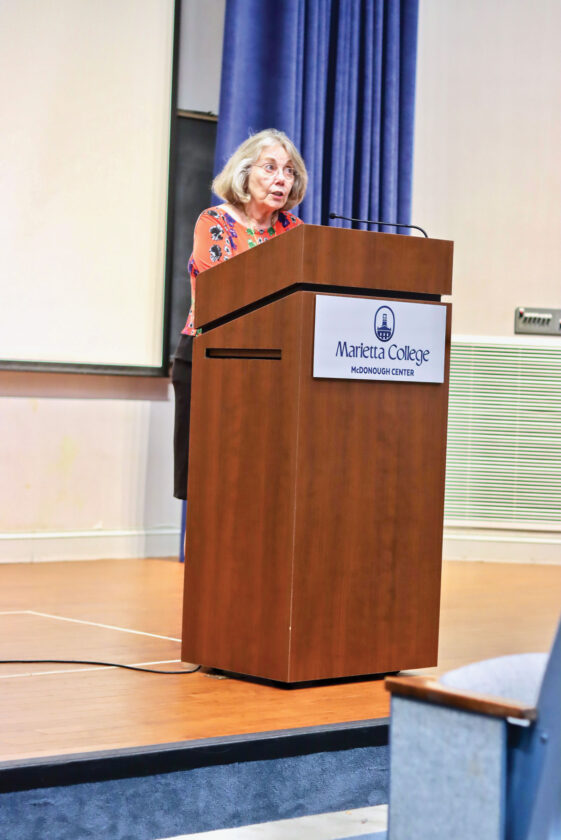
Robin Borglum Kennedy gives her portion of the lecture on her grandfather, Gutzon Borglum, at Marietta College on Saturday. (Photo by James Dobbs)
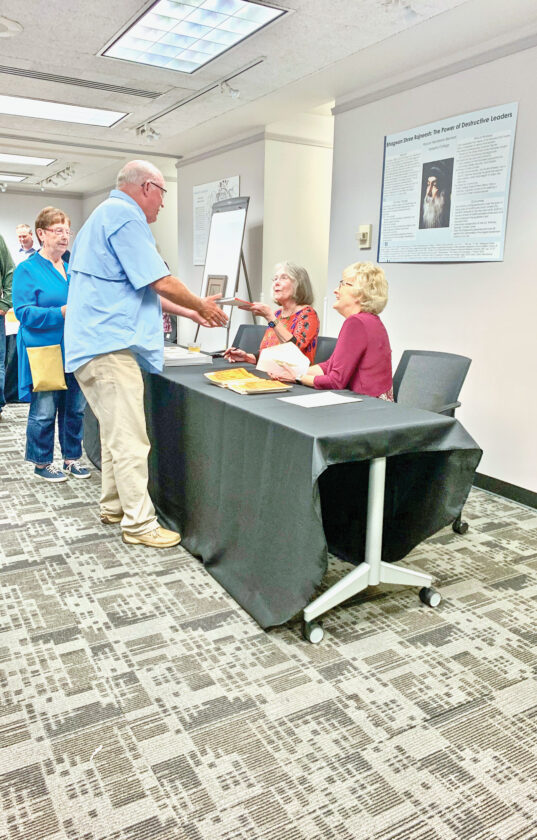
Robin Borglum Kennedy hands over a signed copy of “Gutzon Borglum: His Life and Work,” to Joe Tucker, city of Marietta engineer, during the reception following the lecture. Also pictured is Peggy Grimm. (Photo by James Dobbs)
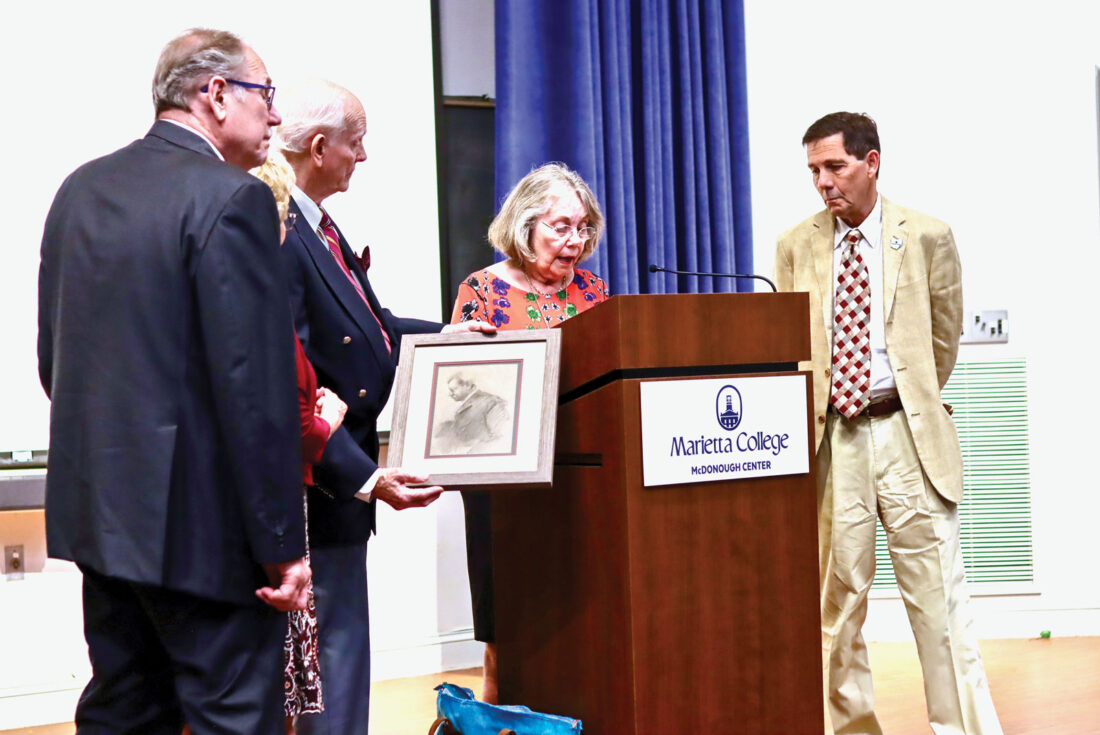
Robin Borglum Kennedy presents Peggy and Joe Grimm, president of the Start Westward Memorial Society, with an ink sketch of Theodore Roosevelt that her grandfather Gutzon Borglum created in 1901. From left, Joe Grimm, Peggy Grimm, John Kennedy, Robin Borglum Kennedy and Jim Borglum. (Photo by James Dobbs)
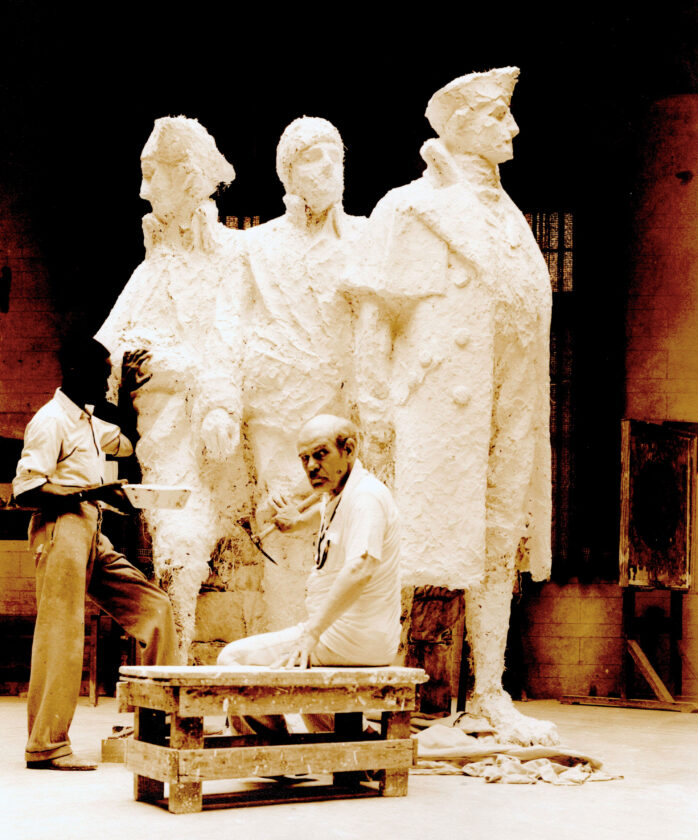
Gutzon Borglum works on the Start Westward monument in his studio. The monument was commissioned for the city of Marietta’s sesquicentennial in 1938. (Photo Provided)
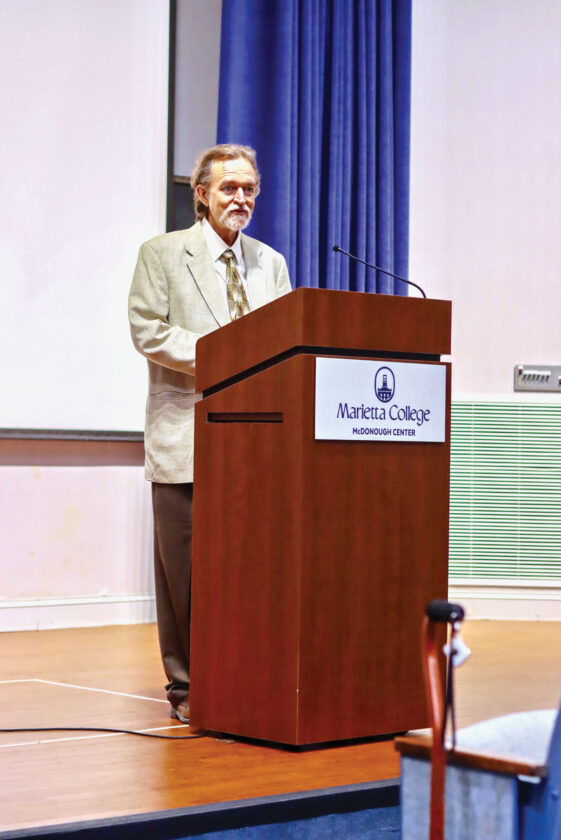
Douglas Anderson, director of the library at Marietta College, opened the Gutzon Borglum lecture by speaking on the Start Westward Memorial. (Photo by James Dobbs)
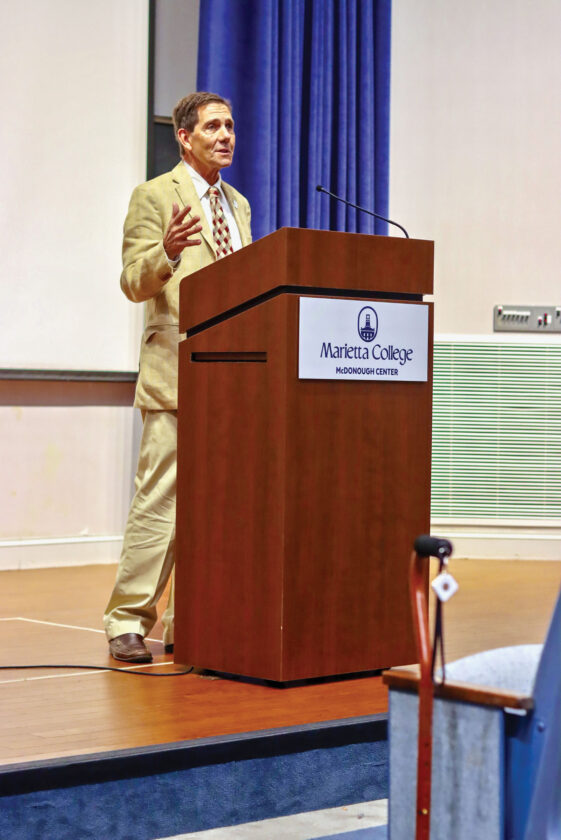
Jim Borglum introduces his sister, Robin Borglum Kennedy, as the next speaker in the lecture at the auditorium in the Bernard McDonough Center for Leadership and Business at Marietta College. (Photo by James Dobbs)
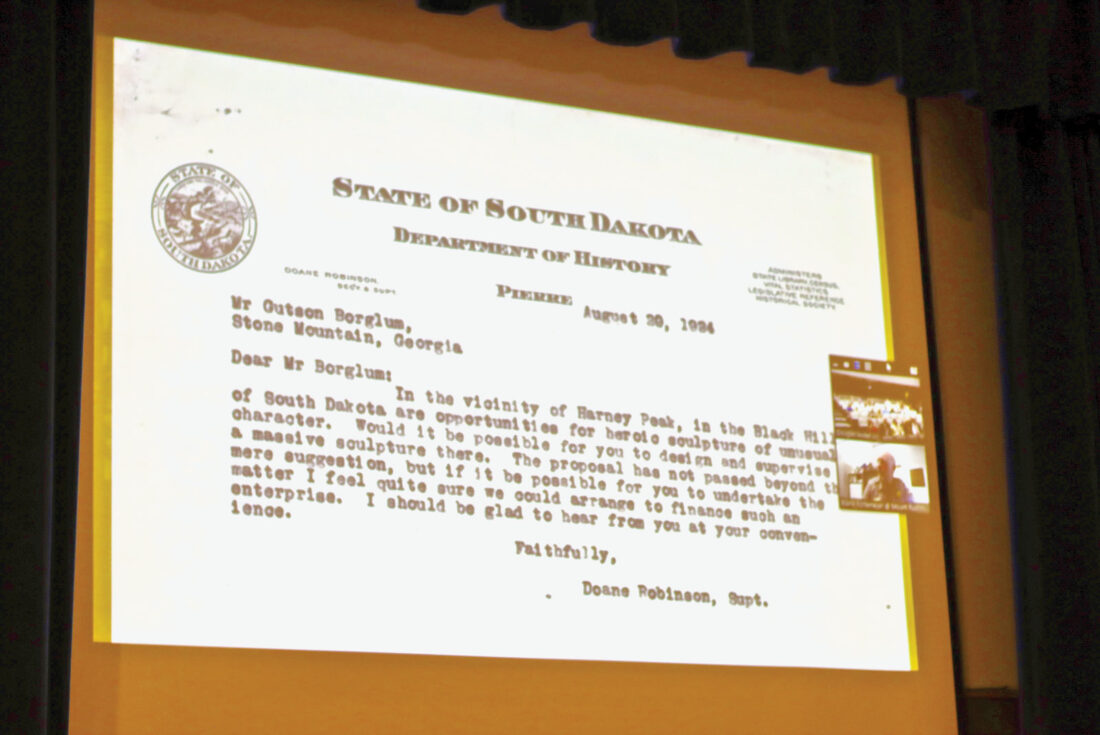
A letter sent to Gutzon Borglum asking him to design Mount Rushmore. This was one of the many slides Blaine Kortemeyer, assistant chief of interpretation and education at Mount Rushmore National Memorial, presented during his portion of the lecture about the memorial. (Photo by James Dobbs)
Robin Borglum Kennedy gives her portion of the lecture on her grandfather, Gutzon Borglum, at Marietta College on Saturday. (Photo by James Dobbs)
Robin Borglum Kennedy hands over a signed copy of “Gutzon Borglum: His Life and Work,” to Joe Tucker, city of Marietta engineer, during the reception following the lecture. Also pictured is Peggy Grimm. (Photo by James Dobbs)
Robin Borglum Kennedy presents Peggy and Joe Grimm, president of the Start Westward Memorial Society, with an ink sketch of Theodore Roosevelt that her grandfather Gutzon Borglum created in 1901. From left, Joe Grimm, Peggy Grimm, John Kennedy, Robin Borglum Kennedy and Jim Borglum. (Photo by James Dobbs)
Gutzon Borglum works on the Start Westward monument in his studio. The monument was commissioned for the city of Marietta’s sesquicentennial in 1938. (Photo Provided)
Douglas Anderson, director of the library at Marietta College, opened the Gutzon Borglum lecture by speaking on the Start Westward Memorial. (Photo by James Dobbs)
Jim Borglum introduces his sister, Robin Borglum Kennedy, as the next speaker in the lecture at the auditorium in the Bernard McDonough Center for Leadership and Business at Marietta College. (Photo by James Dobbs)
A letter sent to Gutzon Borglum asking him to design Mount Rushmore. This was one of the many slides Blaine Kortemeyer, assistant chief of interpretation and education at Mount Rushmore National Memorial, presented during his portion of the lecture about the memorial. (Photo by James Dobbs)
Trending
MARIETTA -- The McDonough Center Auditorium at Marietta College was filled with locals, city officials and history buffs on Saturday for the Gutzon Borglum: His Life and Works lecture.
Douglas Anderson, director of the library at Marietta College, opened the lecture by speaking on the Start Westward Memorial.
"Start Westward Memorial was created as part of a celebration of the sesquicentennial of the adoption of the Northwest ordinance of 1787…," he said.
Anderson explained the idea of a permanent memorial was only one of many celebration ideas discussed in the Marietta Chamber of Commerce in 1934. Some of the other ideas included a national contest for school children and published books.
Anderson stated that Borglum was designing and coordinating the execution of the Start Westward Memorial in the midst of his work sculpting the Mount Rushmore National Memorial. He introduced Blaine Kortemeyer, assistant chief of interpretation and education at the Mount Rushmore National Memorial, as the first speaker of the evening to help provide background information on Borglum's work on Mount Rushmore.
Kortemeyer gave an informational presentation about the history of Mount Rushmore, which included pictures of the monuments' progress over time, as well as Borglum's part in the process and how it came to be. He said Doane Robinson, South Dakota state historian during the 1920s and 30s, thought people would come and see the Black Hills of S.D. if he could get someone to carve western heroes into the mountains. Robinson sent a letter to Borglum in 1924, asking him to supervise a massive sculpture at Harney Peak in the Black Hills. Borglum declined the offer initially, because the location was not suitable and eventually settled on the location where Mount Rushmore sits today.
"In October of 1925, he dedicates the memorial in that location by planting the flag among other things on top of the memorial," he said.
Kortemeyer said the original idea was to only include three presidents, George Washington, Thomas Jefferson and Abraham Lincoln. It was also going to include entablature coming down the face of the sculpture shaped like the Louisiana Purchase with 10 dates representing the first 150 years of our nation's history. Due to difficulties with the granite, Jefferson's sculpture was moved to Washington's left. Theodore Roosevelt was later added.
"The memorial presents an amazing power, all national park sites and historic sites around the world have power," he said. "And it's that power in place that these icons transcend that original idea and become more."
Robin Borglum Kennedy, granddaughter of Gutzon Borglum, was the final speaker of the evening. She discussed the conservation of the Start Westward Memorial, her book and information she learned about her grandfather and father, Lincoln, while digging in the past.
"As some of the rest of the country is tearing down their statues, which erases their history, your community is trying to embrace your history and you're trying to rebuild an attractive area into an example of pride in the legacy that for the next generations is extremely admirable," she said. "You not only have a monument by a prominent American artist, but the beginnings of change in your community of people working together to make this happen. It is going to be truly worth the time and the money and the effort that will be spent in trying to fix everything up."
Borglum Kennedy said after her father passed in 1986, she searched through about 65 boxes worth of photos, letters, negatives and other paper memorabilia. Her brother, Jim Borglum dubbed her as the families "reluctant archivist."
"After 35 years in part because of the pandemic and being quarantined at home, many of those boxes finally did get completely cleaned out and sent to the Library of Congress and some to Mount Rushmore, I'm relieved to say," she said.
Borglum Kennedy said she wrote her book "Gutzon Borglum: His Life and Work," because it was important to her for people to understand his role and place in history.
After her lecture, Borglum Kennedy gave Peggy and Joe Grimm, friend and president of the Start Westward Memorial Society, an ink sketch of Theodore Roosevelt that her grandfather created in 1901. A book signing reception was held immediately following the lecture.
James Dobbs can be reached at jdobbs@newsandsentinel.com.