
Marietta High School grad lands career at NASA
Trending
MARIETTA -- A 1995 Marietta High School graduate is living the dream of many kids who look to the stars for inspiration.
Kristo Kriechbaum, who lives in Altadena, Calif., was "always kind of interested in engineering-type stuff."
"I enjoyed playing with Legos and Tinker Toys," he said.
The Mars Pathfinder rover launched in the mid-1990s sparked Kriechbaum's interest.
"It was tiny, no bigger than a toaster oven," he said. "It blew my mind seeing this little robot on another planet millions of miles away."
After high school, he received a bachelor's degree from Carnegie Mellon University at Pittsburgh, then a master's and doctorate in mechanical engineering at the California Institute of Technology.
Kriechbaum's father, Gary, lived in Marietta for 40 years before moving to Wooster three years ago. Kristo always was interested in space, Gary said.
"Outer space, Star Wars, he had a lot of interest in those things," Gary said. "He was always willing to figure out why something worked or why it didn't."
Kristo always knew he wanted to go into engineering, especially the robotics side of mechanical engineering, Gary said.
"He was very inquisitive, always interested in taking things apart and putting them back together again," Gary said.
Kristo for the last 15 years has worked at NASA where he is a mechatronics engineer.
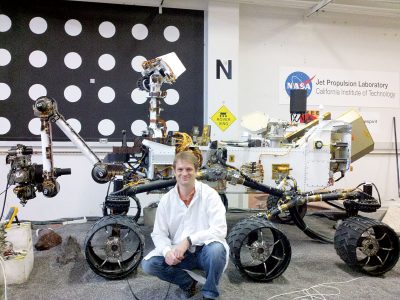
"I've mostly spent time working on the Curiosity rover and the Perseverance (rover)," Kristo said. "The big thing for Mars is searching for signs of past life. As the rovers have progressed in size and capability, I think most of the scientists believe it was habitable at some point."
The size of the rovers have grown in size from the toaster oven-sized Pathfinder to the car-sized Curiosity and Perseverance.
"It's about the size of a small car, like a Mini Cooper," he said.
In his biography on NASA's website about the Mars 2020 sampling system, Kristo led the experimental design and data analysis for the subsystem's development. He also worked on proposals for Venus landers and worked on advanced development for a Europa lander mission.
The sampling subsystem takes core samples from the surface of Mars, puts them in containers and drops them on the ground, Kristo said. Two other missions will retrieve the containers and take them to Earth.
"We hope to launch in 2026 or 2028 to pick them up and send them back to Earth," Kristo said. "It will still be a little lander and smaller rover to grab the sample tubes. They will be stuck into a small rocket and launch into Mars' orbit."
He said the third mission will grab the basketball-sized capsule from orbit for the journey to Earth. The missions are in the early phases.
"It's still just amazing to think there's this piece of hardware I've touched in a clean room is now hundreds of thousands of miles away on another planet," Kristo said. "It doesn't get old."
He enjoys his job because every problem is unique and he works with a huge team of people.
"We all have that common goal of making these awesome robots to explore planets and moons," Kristo said.
Michele Newbanks can be reached at mnewbanks@mariettatimes.com.