
West Virginia unveils one-stop permitting portal ahead of schedule
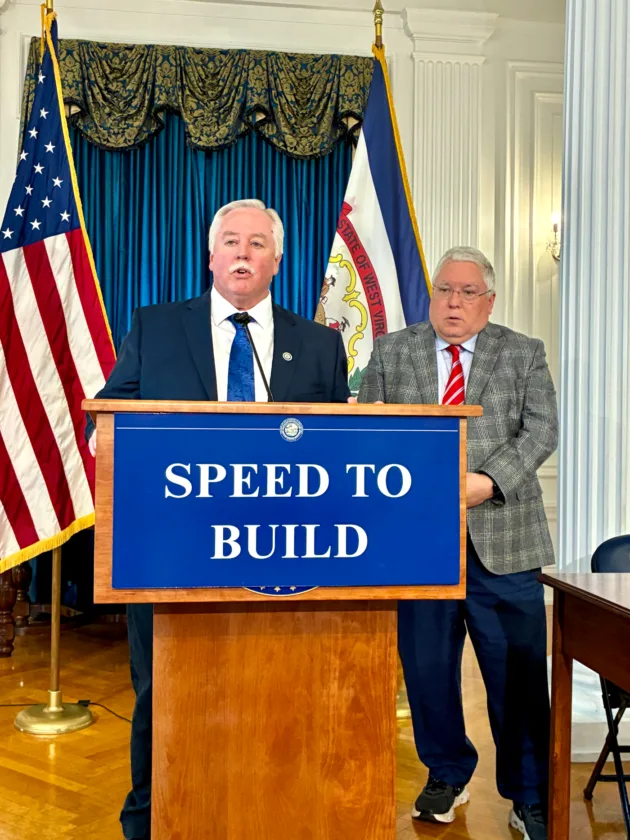
Department of Administration Cabinet Secretary Eric Householder (left) and Gov. Patrick Morrisey (right) unveiled the new West Virginia Speed to Build Permitting Portal during a press conference at the State Capitol Building Wednesday. (Photo by Steven Allen Adams)
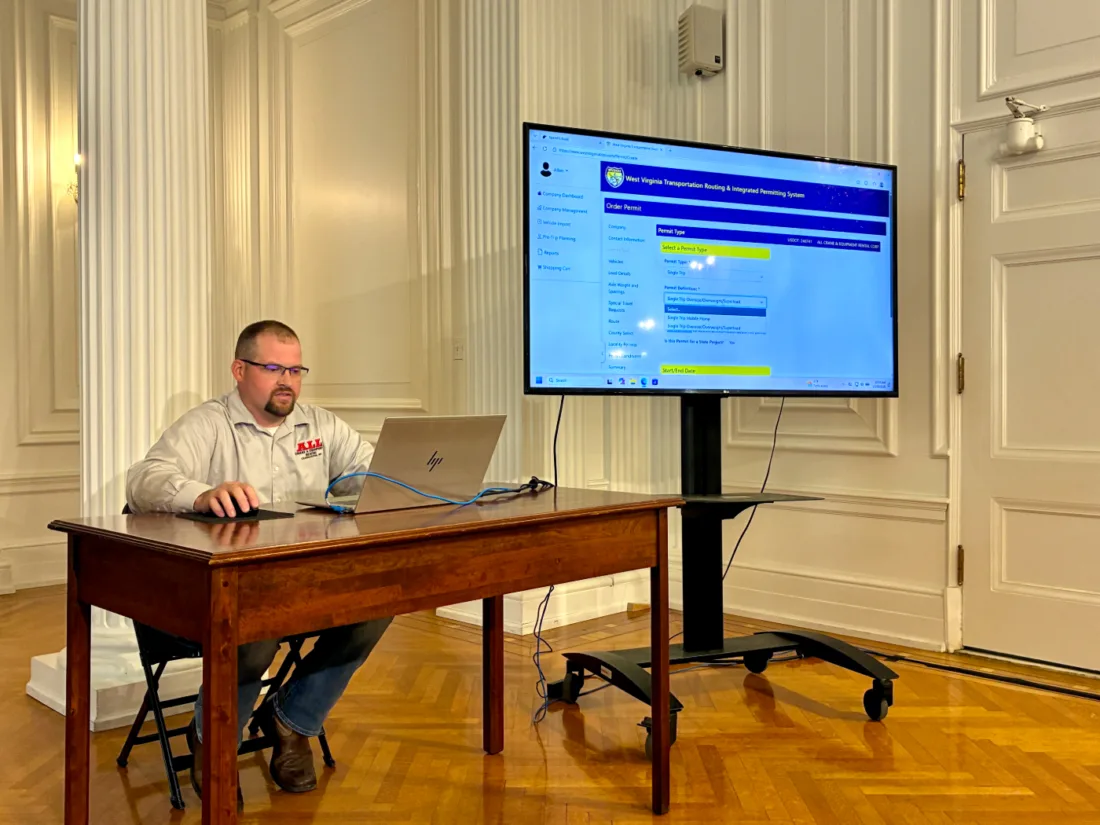
Allen Hudson, a dispatcher for Nitro-based All Crane and Equipment, demonstrated how to apply online for a hauling permit using the new West Virginia Speed to Build Permitting Portal during a press conference at the State Capitol Building Wednesday. (Photo by Steven Allen Adams)
Department of Administration Cabinet Secretary Eric Householder (left) and Gov. Patrick Morrisey (right) unveiled the new West Virginia Speed to Build Permitting Portal during a press conference at the State Capitol Building Wednesday. (Photo by Steven Allen Adams)
Allen Hudson, a dispatcher for Nitro-based All Crane and Equipment, demonstrated how to apply online for a hauling permit using the new West Virginia Speed to Build Permitting Portal during a press conference at the State Capitol Building Wednesday. (Photo by Steven Allen Adams)
Trending
CHARLESTON – State officials celebrated the soft-launch Wednesday of West Virginia’s new online one-stop portal for permitting three months ahead of a statutory deadline, with online-only permitting going live by the middle of next year and a great use of AI chatbots across all state departments expected.
Gov. Patrick Morrisey and state Department of Administration Cabinet Secretary Eric Householder announced during a Wednesday morning press conference in the Governor’s Reception Room at the State Capitol Building that the West Virginia Speed to Build Permitting Portal was live after a soft-launch on Oct. 1.
The permitting portal, located at SpeedtoBuild.wv.gov, consolidates approximately 330 permit types across 13 state agencies and is designed to process roughly 178,000 permits annually.
“We’re excited about this new one-stop shop,” Morrisey said. “We know that there are a lot of entities here that might need permits from different state agencies, each with their own forms, their own processes, and own way of collecting fees ... Well, that all changes today because we have a cutting-edge permitting portal that brings all that together in one place.”
House Bill 2002, introduced on behalf of Morrisey and passed by the Legislature in 2025, established the One Stop Shop Permitting Program, designed to modernize and streamline the acquisition of licenses, business registrations, and permits for construction and economic development.
Overseen by the Secretary of the Department of Administration, the law mandated the creation of a centralized permitting dashboard to launch by Jan. 1, 2027. The Speed to Build online portal allows individuals and businesses to establish private accounts to submit paperwork, track application statuses, communicate with regulators, and electronically pay associated fees. The legislation provides a fast-track processing option for an extra fee.
As part of HB 2002, participating state agencies were required to establish clear processing timelines. Beginning on Jan. 1, failure to meet these deadlines will require agencies to issue a full refund of application fees to the applicant. The law also mandates the end of traditional paper applications by July 1, 2027, with direct agency submissions remaining optional until then.
“Beginning January 1, 2027, you’ll have the option to expedite your permit application with the guarantee that you will receive your approved permit in that time or you will get your money back,” Householder said. “By July 1, 2027, all permits currently in the portal will be applied for and processed digitally. This showcases a phased-in approach in how you submit, how you pay for, and how you track your permit applications.”
According to Householder, more than 8,000 permits have been processed since the portal went live on Oct. 1. Nitro-based All Crane and Equipment Rental is one of the portal’s first 1,536 users who have already used the system to request hauling permits.
“We feel this portal will make our permit application more speedy, efficient, and allow us to spend more time dealing with our customers,” said All Crane General Manager Chad Shamblin as his dispatcher Allen Hudson sat at a computer and went through the process of applying for a hauling permit. “it’s very nice, works very well, quick, and turns things around instantly.”
Representatives of various industries were also on hand for Wednesday’s press conference, including representatives of the construction and coal industry who praised the new portal.
“A portal like this is something that’s going to allow us to fulfill your vision of speeding up the way we do business,” said West Virginia Contractor’s Association CEO Jason Pizatella to Morrisey. “The quicker we can get a permit approved means we can get shovels in the ground and we can work faster, and it’s really a game changer for the industry.”
“We feel that this one-stop permitting and this process will truly expedite those various components and, no question, shrink that time down,” said West Virginia Coal Association President Chris Hamilton. “We look forward to utilizing this process.”
Backed by a $5 million general revenue budget allocation, primary development was executed via a $655,000 three-year contract (with options for three-year renewals) with Delaware-based software company Delasoft, supplemented by a communications contract with the Manahan Group valued at approximately $550,000. Twenty-nine bids were received on Aug. 29, 2025, narrowed down to 14 bidders by December 2025 before the contract was awarded to Delasoft on Jan. 8, 2026.
According to Morrisey, West Virginia is one of seven states with a permitting portal offering an AI-powered assistant named “Annie” that will guide applicants step-by-step through the online permitting process. Morrisey said state agencies will still exercise rigor in ensuring permit requestors are following all applicable laws and that the permits receive the appropriate scrutiny.
“Compliance with the law is important to me as former attorney general and someone who cares about the rule of law,” Morrisey said. “We’re going to have to keep monitoring that, and we’re going to make sure that it’s done right. But I do think having the extra resources, that’ll certainly help to meet the accelerated timelines.”
The new permitting process and use of AI could also reduce the need for full-time state employees, though Morrisey said it was too soon to say. At the beginning of his first year in office, Morrisey directed all state departments and agencies to conduct audits and identify ways to be more efficient. Morrisey has also introduced bills since 2025 and make several classifications of state employees will-and-pleasure and reduce rights within the state’s public employee grievance system.
“We always have to be focused on looking out for the best interest of taxpayers,” Morrisey said. “You want to put the right amount of people on the project that’s needed to comply with the law and to service the public, our customers, the right way. I always ask our agencies to look through and ask them, how many people do we need to perform the function? As this process is implemented, I certainly am going to be asking those questions as to what that means.”
The Speed to Build Permitting Portal also represents a larger shift by state departments and agencies towards AI-based customer service. In July, the Office of Technology entered into a $432,000 three-year sole-source contract with Texas-based Vulcan Technologies for state agencies to incorporate the company’s Justinian AI chat agent into department and agency websites.
“We’re moving rapidly in the direction of AI, and AI is taking up more and more functions in our society,” Morrisey said. “As that happens, AI is going to be able to perform certain things that perhaps people are performing right now. As a state government, we’re going to have to analyze all that to make sure how we can run state government in the most efficient manner possible. And so certainly we’re going to keep asking those questions.”
“We care very much about our state workers and ensuring that we know that so many are doing so many wonderful things, but we owe it to the taxpayers to keep asking questions about how we can become more efficient,” Morrisey continued.