
More support needed for childcare expansion, panelists say
Trending
WHITE SULPHUR SPRINGS - A bill that became law without the signature of Gov. Patrick Morrisey earlier this year to improve access and affordability for childcare is helping, but panelists at a business-focused summit this week said more help is needed.
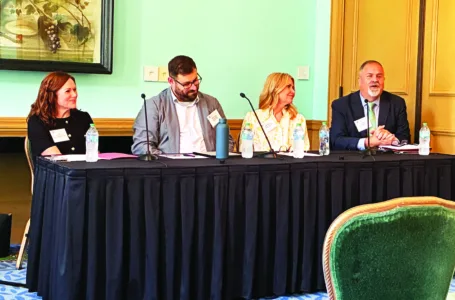
The West Virginia Chamber of Commerce’s 90th Annual Meeting and Business Summit played host to several breakout sessions Wednesday at the Greenbrier Resort. One of those sessions was the "Economics of Investing in Childcare," moderated by Brian Dayton, vice president of policy and advocacy for the chamber.
Earlier this year, the West Virginia Legislature passed House Bill 4191, which proposed tax credits for businesses that either build on-site facilities or financially back third-party childcare providers for their staff. The bill increases the employer tax credit for childcare facilities from 50% to 100%.
HB 4191 mandates a shift toward enrollment-based subsidy payments instead of attendance-based, providing childcare providers with a predictable revenue stream regardless of daily attendance fluctuations. It transitions a reimbursement system managed by the state Department of Human Services from paper-based, mail-in billing to electronic documentation to speed up payments.
House Finance Committee Vice Chairman Clay Riley, R-Harrison, said HB 4191 started as a bill to expand the employer childcare tax credit but soon became a vehicle for several other pro-childcare policies.
Fifteen early childhood education bills were in the Legislature this year, according to Riley.
"And a lot of them had hearings in different committees and they passed around," he said. "And I think what that generated was sort of almost a resolve … that hopefully begins to move the needle."
The bill also reduces the hourly requirement for "full-day" billing from four hours to two-and-a-half, making it more attainable for after-school programs to remain financially viable. Riley said this, combined with enrollment-based subsidy payments, should help bring more financial certainty for childcare providers.
"What that will allow us to do is be more predictable in what our revenue streams are," he said. "It'll allow us to have more predictability in the staffing that we provide. … As business folks, we all know, stability allows us to make smarter investments."
"What that means is that enables us to be able to receive payment for the enrollment of that child throughout the month versus the days," said Sarah Bolyard, president and CEO of the YMCA of Kanawha Valley, which offers childcare services. “That’s why this legislation was so important. The biggest piece of that was that it dropped that requirement down, from four hours, but to 2.5 hours, which makes it more attainable for us to be able to bill for a full day and thus receive a full month of reimbursement, which is what we need as providers to stay in business."
State reimbursement rates for subsidized children have remained largely unchanged for approximately 15-18 years, Bolyard said. Significant increases in food, utilities and insurance costs have pushed many providers into the red. One provider reported an $87,000 loss over the previous year despite making staff cuts.
According to Bolyard, DoHS just implemented the full-day billing requirement Wednesday, the same day as the childcare panel. HB 4191 became law this year without Morrisey’s signature. According to West Virginia Watch, much of HB 4191 remains unimplemented by DoHS despite the bill taking effect on July 1.
Dayton said that more than three-quarters of the membership of the state Chamber of Commerce cite childcare accessibility and affordability as the primary barriers to talent recruitment and retention. West Virginia has the lowest workforce participation rate in the country at 54.8%.
"In a state where we have the lowest workforce participation in the country, that is one of the key issues," Dayton said. "We have a firm belief that addressing childcare is one of the absolute fundamentals if we’re going to go ahead and start raising our workforce participation and being more pro-family in West Virginia."
Leeann Kaminsky, senior vice president and human resources officer for WVU Health System, one of the largest employers in the state, said childcare is no longer just a benefit, but a necessity for recruitment and retention.
"Childcare really just isn’t a family issue anymore," she said. "It is a workforce issue. It’s a retention issue. It’s a recruitment issue. It’s an engagement issue for our employees.”
WVU Health offers childcare services, but Kaminsky said high costs and long waiting lists prevent skilled workers, particularly in nursing, from returning to the workforce.
"We have a lot of young childbearing nurses who work for us," she said. "And a lot of times, they’re not coming back to work after they’ve had their children because number one, it’s not worth it for them. They can’t afford it."
Another major deterrent to economic mobility is the current childcare subsidy structure. Families receiving state assistance often face a "subsidy cliff" where a minor increase in income results in the total loss of childcare funding. Panelists said such scenarios encourage workers to remain on public assistance or exit the workforce entirely to avoid the sudden cost of full-price childcare.
One childcare program that started as an eight-county pilot project is now going statewide thanks to a $5 million appropriation by the Legislature. The Tri-Share program, managed by Wonderschool, splits the cost of a childcare bill into three equal or flexible parts, with the employer contributing a portion of childcare funding as a retention/recruitment tool, the state providing a public match and the employee paying the remaining difference.
"West Virginia became one of very, very few states around the country that now has a statewide tri-share program," said Marcus Keech, the government relations and Tri-Share Partnerships lead with Wonderschool. "The Legislature looked at a pilot, determined it was successful, and decided to fund it with state dollars instead of depending on federal funds that might not come."
Steven Allen Adams can be reached at sadams@newsandsentinel.com.