
Capito, Justice focus remarks on energy at 90th annual W.Va. Chamber meeting
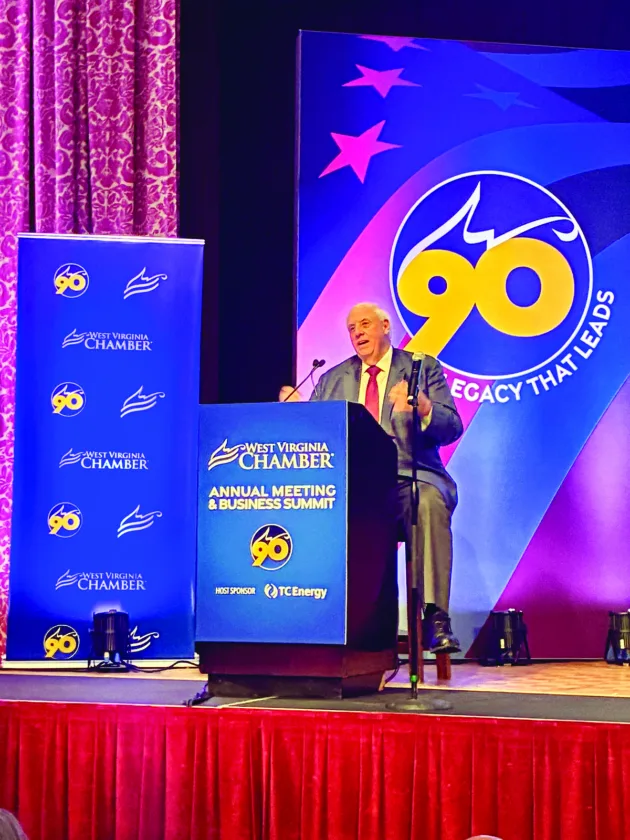
U.S. Sen. Jim Justice, R-W.Va., told attendees of the West Virginia Chamber of Commerce 90th Annual Meeting and Business Summit Thursday that there is a middle ground for supporting data center projects while addressing the concerns of opponents. (Photo by Steven Allen Adams)
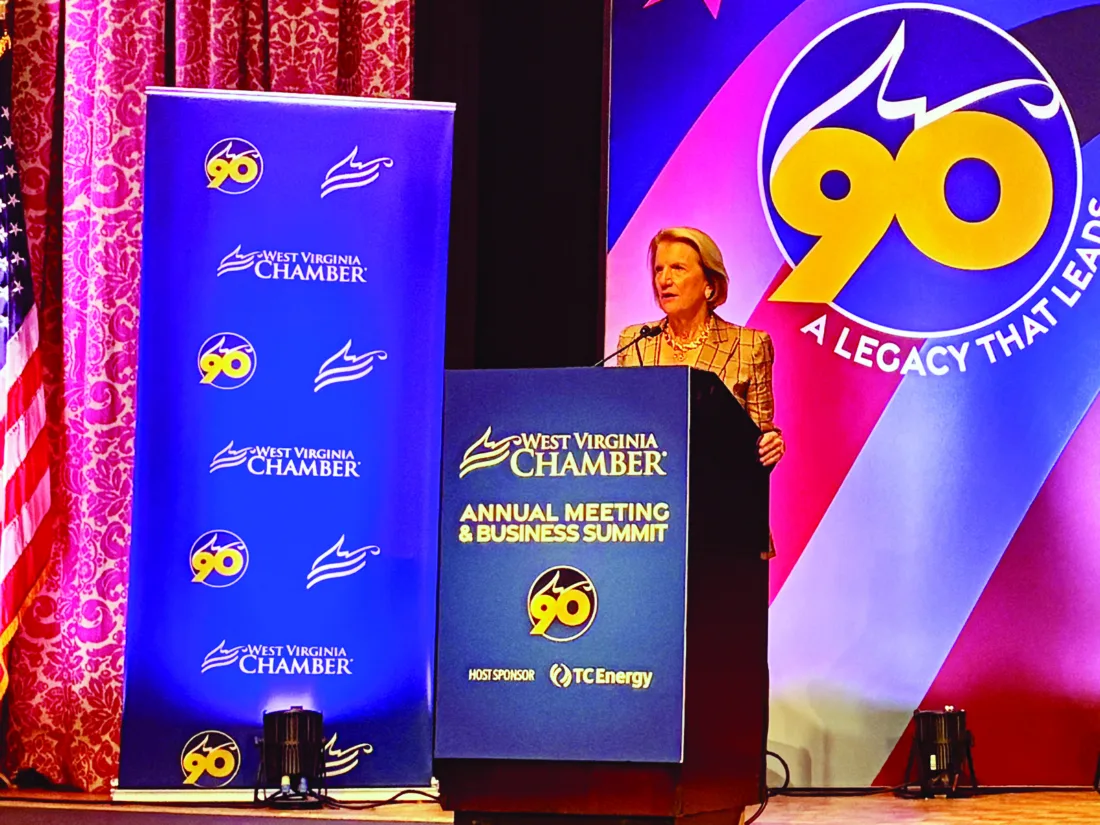
U.S. Sen. Shelley Moore Capito, R-W.Va., said bipartisan conversations in Congress are leading lawmakers toward a deal on permitting reform during remarks at the West Virginia Chamber of Commerce 90th Annual Meeting and Business Summit at the Greenbrier Resort. (Photo by Steven Allen Adams)
U.S. Sen. Jim Justice, R-W.Va., told attendees of the West Virginia Chamber of Commerce 90th Annual Meeting and Business Summit Thursday that there is a middle ground for supporting data center projects while addressing the concerns of opponents. (Photo by Steven Allen Adams)
U.S. Sen. Shelley Moore Capito, R-W.Va., said bipartisan conversations in Congress are leading lawmakers toward a deal on permitting reform during remarks at the West Virginia Chamber of Commerce 90th Annual Meeting and Business Summit at the Greenbrier Resort. (Photo by Steven Allen Adams)
Trending
WHITE SULPHUR SPRINGS - The second day of the West Virginia Chamber of Commerce's 90th Annual Meeting and Business Summit started off with a focus on energy and the state’s two U.S. senators suggesting the nation should turn to the Mountain State once again.
Sens. Shelley Moore Capito and Jim Justice spoke to a record crowd Thursday morning at the Greenbrier Resort about the need for West Virginia to play a role in generating electricity and the importance of energy infrastructure.
"There’s three ways for this country to prosper in ways like you can’t imagine, and it’s energy, energy and energy," said Justice, R-W.Va. "I will promise you I’m right about this. And West Virginia is right dead in the bullseye. ... Energy touches every single thing we have in every way.
"I would say do all you possibly can to remember who brought you to the dance. ... The great natural resources of this unbelievable state," he continued. "Coal and oil and gas and so on and so on. It brought you to the dance. For God’s sake a-living, don’t forget them. And love them and embrace them like you can’t possibly do it any other way."
"The state is blessed with a lot of natural resources and fossil fuels,” said Capito, R-W.Va. "(But) you can’t do (energy infrastructure) the way we should be doing it in a country like ours to be able to prosper and grow as quickly as we need to grow to be the supreme power in the world and retain that."
Capito, the chairwoman of the Senate Environment and Public Works Committee, is working with the committee’s ranking Democratic member, U.S. Sen. Sheldon Whitehouse, D-R.I., and the leadership of the Senate Energy and Natural Resources Committee on a permitting reform package aimed at speeding up infrastructure projects, such as natural gas distribution and electric transmission line projects.
"We are in the midst of negotiating something that I think could be game-changing for the country, and this is permitting reform," Capito said. "We know that permits are too expensive and take too long. People back out of projects. ... There’s money sitting on the table to the tune of $2 trillion because (companies are) not sure if the political winds will blow one way or the other and whether their projects can get built."
Capito said key parts of a potential bipartisan permitting reform bill could include narrowing the judicial review process for infrastructure projects, a streamlined Clean Water Act permitting process and reducing the number of federal regulations that tie up proposed projects for years.
"We are right down to the finish line, and we will know, I think next week, whether we’re able to bridge that gap," Capito said. "It’s going to be bipartisan. I’m not going to get everything I want. And Sheldon Whitehouse is not going to get everything he wants ... but we’re doing what you sent us to do there: sit down, put the pencil on the pad of paper, and figure out where we can get the best deal for both of us."
Justice urged attendees not to be afraid of data centers, with several projects underway or on the drawing board in West Virginia. Data center construction, driven by growing use of artificial intelligence - AI - has received pushback from people concerned about the possibility of higher electric bills, the use of fossil fuel-powered microgrids causing noise and pollution, water usage, and local control.
“I oftentimes think about my dad. ‘Son, if you go into a restaurant and the waitress comes over and says sir, do you like your eggs scrambled or fried? What should you say? Yes,’" Justice said. "Think about it. Do we like our data center scrambled or fried? I would say yes. I would say there’s a way to have it all. There’s a way to have your cake and eat it too."
Justice said companies wanting to locate data centers in West Virginia need to be responsible neighbors and work with communities to address concerns. But he believes there is a path for both supporters and opponents of data centers to get what they want.
"If you’re going to come to West Virginia and you’re going to do something in West Virginia, you need to be taking care of everybody," Justice said. "The environment, the water, the electricity bills, the noise. You’ve got to take care of everybody, and there’s a way to do it."
Steven Allen Adams can be reached at sadams@newsandsentinel.com.