
Scaling New Peaks: Benson sets new ‘Strategic Compass’ for West Virginia University
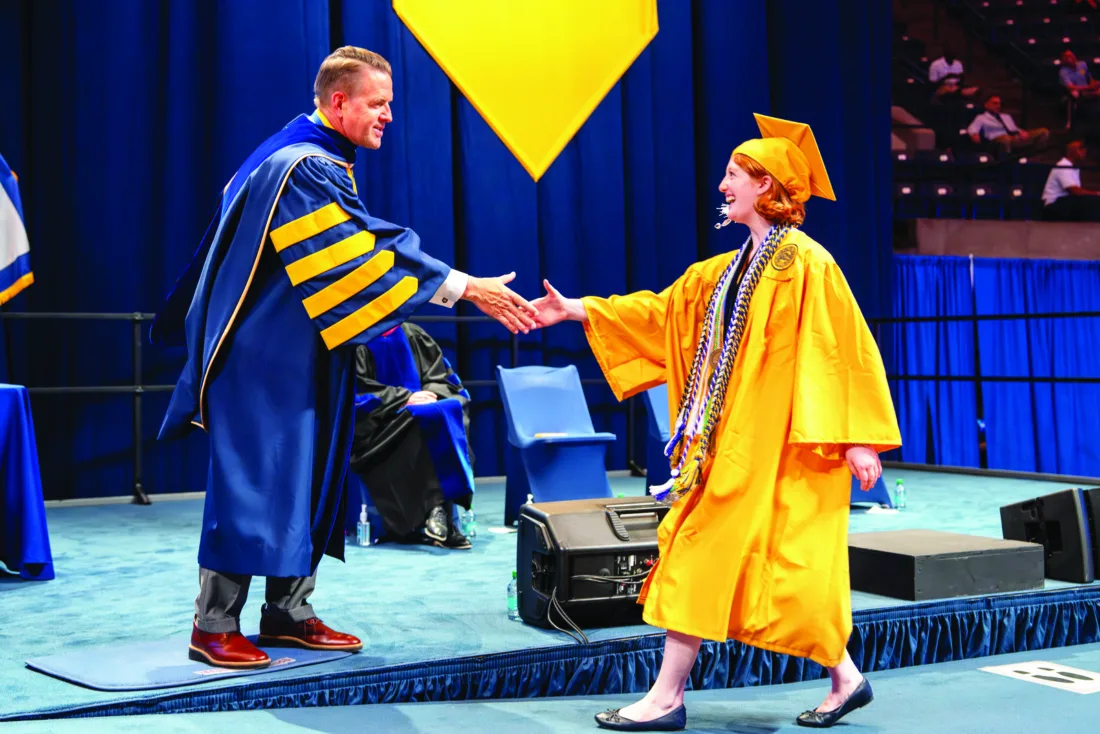
WVU President Michael Benson shakes a graduate’s hand on stage in the Hope Coliseum at the Eberly College of Arts and Sciences Commencement in Morgantown on May 17. (Photo courtesy/West Virginia University)
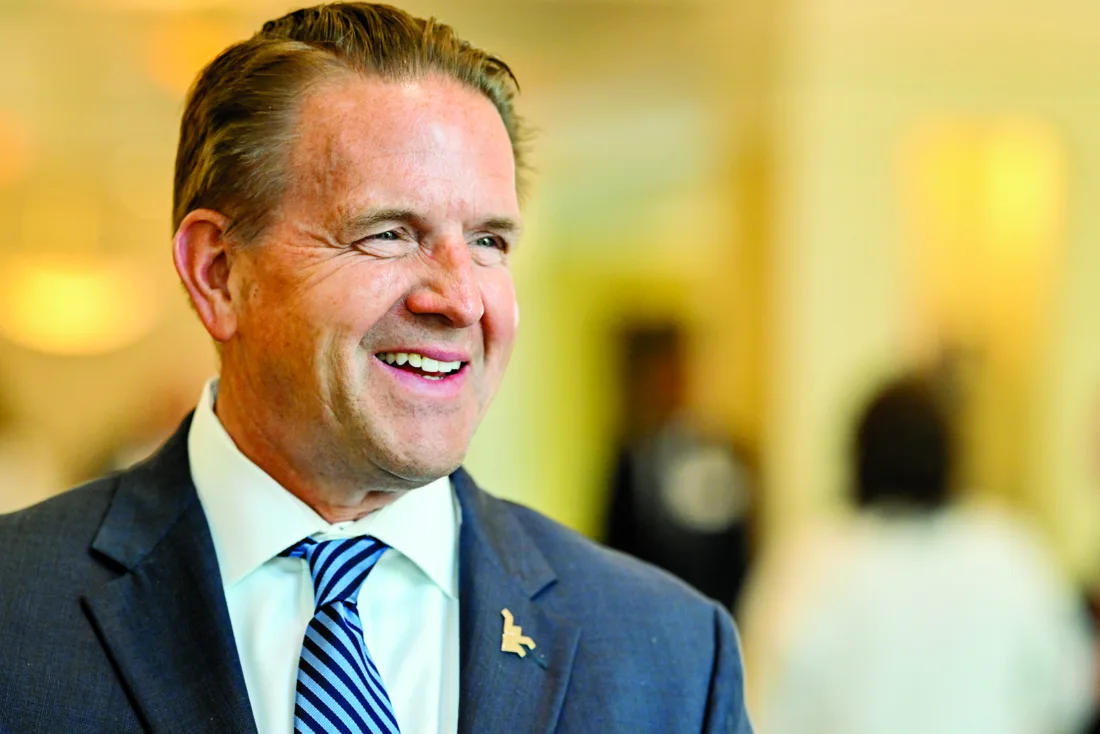
President Michael Benson smiles as he talks with guests following the faculty and staff annual awards at Blaney House in Morgantown on April 24. (Photo courtesy/West Virginia University)
WVU President Michael Benson shakes a graduate’s hand on stage in the Hope Coliseum at the Eberly College of Arts and Sciences Commencement in Morgantown on May 17. (Photo courtesy/West Virginia University)
President Michael Benson smiles as he talks with guests following the faculty and staff annual awards at Blaney House in Morgantown on April 24. (Photo courtesy/West Virginia University)
Trending
MORGANTOWN - Michael Benson is just over a year into his role as the 27th president of West Virginia University, but after a 55-county tour putting in more than 6,600 miles and 3,900 handshakes, Benson is ready to look forward and add to the pride people feel about WVU.
"I want the people of West Virginia to be proud of the university. I think that’s really, really essential," Benson said in an interview at Stewart Hall. "And to graduates, when they look at the diploma on the wall, it means more to them as the years go by, as opposed to being diminished. I think that’s really important as well."
Benson took office as WVU’s president on July 15, 2025, succeeding E. Gordon Gee, who returned to helm the university for 11 years beginning in 2014 after previously serving as WVU president from 1981 to 1985.
After serving as president of Coastal Carolina University beginning in 2021, WVU is Benson’s fifth presidency of a higher education institution, with prior experience at Snow College, Southern Utah University and Eastern Kentucky University.
After beginning his tenure in Morgantown, Benson set off on a 55-county tour of West Virginia to rebuild connections and highlight local communities. Benson said he was no stranger to the Mountain State, but his travels over the past year showed him West Virginia's diversity both in its geography and its people.
"Driving as many miles as we did in the car ... you got to see a lot of windy roads and a lot of beautiful kind (of) aha moments where you come around the bend and you stop and see this vista," Benson said. "I fell in love with the beauty of West Virginia, and that was only eclipsed by, really, the beauty of the people. Because everywhere I went, I met just amazing people. Amazing."
Benson said the last 13 months have shown him the influence of WVU and West Virginia on the national stage, including WVU baseball’s historic run at the College World Series in Omaha; the mass singing of "Take Me Home, Country Roads" at the World Cup; the university’s connections to its alumni, which Benson called "Mountaineers in diaspora;" and the graduates who walked across the stage earlier this year who now have a shared bond with the school.
One of Benson’s challenges is changing perceptions outside the state about WVU and what it is capable of. From research to business to medicine to the College of Law, Benson said WVU graduates and alumni can compete in any sector.
"I was a little disappointed in the fact that people outside of West Virginia I don’t think appreciate just how sophisticated a place the university is," he said. "I think one of my primary responsibilities as the president is to help tell that story. And you do it through the powerful examples of your alumni, your current students, your faculty, your staff."
Benson’s tenure follows the Academic Transformation begun under Gee’s presidency to address a $45 million structural deficit. In 2023, the WVU Board of Governors voted to eliminate 28 programs, 10 undergraduate programs and 18 graduate programs, and merged three other programs into existing degrees. Another 13 programs saw reductions in faculty. More than 300 positions were cut.
Gee was criticized at the time by students and faculty for initiating the Academic Transformation, but several colleges around the nation - such as Penn State and Syracuse - are now having to follow in WVU’s footsteps and make cuts in programs and faculty. Benson said university officials are always reviewing programs to remain flexible and address career demands, but he said the university is looking forward, not behind.
"It was kind of a steady climb," Benson said. "It was a challenging period, and I saw my opportunity as one to build as opposed to talking about the past and say, 'OK, this is where we are, and this is what we’re going to do, and this is how we’re going to move forward.' I’ve tried to be incredibly positive and focus on the areas where we can really make a difference, which are manifold."
Benson has also used his first year to rebuild trust with students, faculty and staff at WVU and its sister campuses at Potomac State University and WVU Institute of Technology. Benson said his goal is to spend more time on campus versus in his office and be accessible.
"I try to be very open and transparent and kind of be out there," Benson said. "As much as I love Stewart Hall, I don’t like to spend a lot of time behind my desk because I think the way you get to know a place and the people is be out among them. ... I really have tried my best to be open, to not dodge the hard issues, to hire really good people. I had a meeting today with our provost who told me a faculty member said to her, ‘For the first time, I feel like we have some hope.’ And hope is a good thing."
Benson summered up the state of WVU in one sentence: “West Virginia is a vibrant, dynamic Research 1 land grant university that takes very seriously its role in that capacity and has a bold vision for the future with focus on teaching, research and service."
The hallway outside of Benson’s office is lined with quotes from President John F. Kennedy. Approved by the WVU Board of Governors last December, Benson launched in April his Strategic Compass, a JFK-inspired five-year plan for the university which includes two "moonshot" goals to guide the university's future.
"'We choose to go to the moon and do other things, not because they’re easy, but because they’re hard.' I’ve always been inspired by that statement because it was one of those kind of markers in the sand. ... This is what we’re going to do," Benson said.
Moonshot goal one is earning a National Cancer Institute designation for the WVU Cancer Institute. Benson said only approximately 69-71 institutions in the U.S. and Canada hold this status. Moonshot goal two is WVU joining the Association of American Universities, which Benson said would elevate school’s academic reputation and enhance the ability to attract federal research dollars.
"As I’ve told people, if the University of South Florida, which used to be a partner school with us in the Big East, if they can accomplish that as a kind of urban university, we can do it as a rural university," he said.
Benson said the metric for success he should be judged by in future years is better student outcomes, higher graduation rates and better opportunities for employment after leaving the university.
"The university exists to support them, so their academic record while they’re here, the job we do in teaching them and inculcating into them, yes, knowledge about their specific subject, but also a value system; the ability to treat others with respect and to have the ability to disagree without being disagreeable, I think that’s really, really important," Benson said.
The next challenge for WVU and higher education in general is the enrollment cliff, caused in part by declining birthrates over the last 18 years reducing the number of high school graduates and potential college students. The reduced pool of graduates will create a competition between in-state colleges and universities and neighboring states for students. Benson said WVU is preparing as best it can.
"I think the time will tell whether we’re prepared because, again, you can gauge it by your incoming freshman class, but the most important metric is your staying power, your retention number, and by association, of course, your graduation rate," he said.
"We are making sure we’re putting together financial aid packages that we can afford that ... don’t increase our discount rate, and we get the right mix of in-state and out-of-state students,” Benson continued. "And I want to make sure I’m very clear on this: There is a place for every West Virginia high school graduate who wants to come to West Virginia University."
WVU is also working on being a better neighbor in Morgantown, creating a safer campus that students and the community can enjoy. WVU’s 121-foot rusted tower was repainted white with 10-foot “WV” logos, funded through a partnership with Hope Gas, to improve the university’s appearance in national media broadcasts. The university and city are collaborating to ensure entry points into Morgantown are well-maintained, and Benson re-established the tradition of lighting Woodburn Hall as a community gathering spot.
Benson said WVU is working to identify locations on campus to create quads and other student gathering locations. And the university is doing traffic and safety studies that could involve closing certain roads to direct traffic behind the Mountainlair and installing a roundabout at Beechurst and Eighth Street to address safety issues.
"I think the university needs to be right at the epicenter in terms of, yes, the resources that we have to bring to bear, but also our willingness to cooperate and to partner," Benson said. "Students breathe life into town. They help with our local businesses and so forth. But I don’t want ever us to take for granted the impact that we have on the ... people that live here year-round. And so I’m very mindful of that."
In five years, Benson said he hopes that pride in West Virginia University will grow, and its reputation will become better known throughout the state and nation for the quality of its students and alumni.
"I would like us to continue to improve our academic reputation, to continue to produce graduates that go out and make a difference in the world, continue to have great pride in the mission of the university, get continual support from our state, which we’re very grateful for, but also raise more private dollars that can kind of increase that margin of excellence," he said. "I’d love to see our athletic teams continue to do well. I’d love to see continual improvements to our campus itself and to continue to beautify it."