West Virginia awarded nearly $200M through federal Rural Health Transformation program
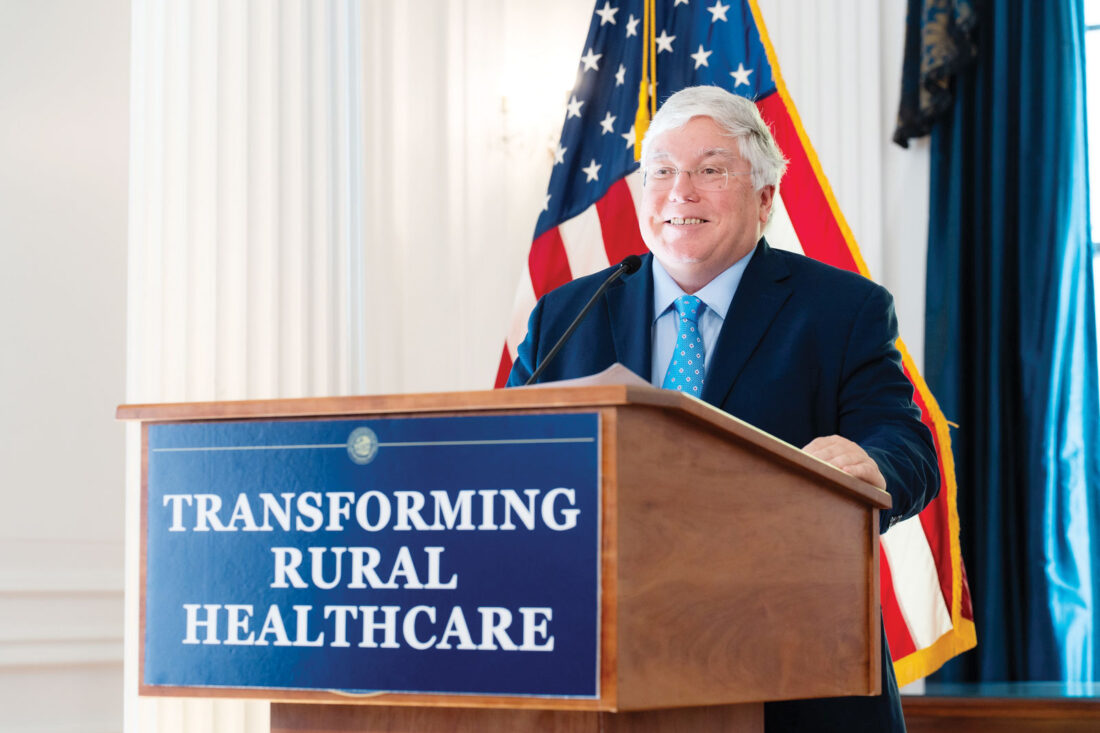
Gov. Patrick Morrisey, seen here during a Nov. 6 press conference announcing that West Virginia submitted its federal Rural Health Transformation application, praised the award announced Monday of $199.5 million to the state for the first year of the program. (Photo Courtesy/WV Governor’s Office)
CHARLESTON — West Virginia is set to receive nearly $200 million for the first year of the new federal Rural Health Transformation program. The U.S. Centers for Medicare & Medicaid Services (CMS) announced Monday that all 50 states will receive awards through the $50 billion Rural Health Transformation program made possible through President Donald Trump’s One Big Beautiful Bill Act, now called the Working Families Tax Cuts Act. “More than 60 million Americans living in rural areas have the right to equal access to quality care,” said Robert F. Kennedy Jr., secretary for the U.S. Department of Health and Human Services. “This historic investment puts local hospitals, clinics, and health workers in control of their communities’ health care. Thanks to President Trump’s leadership, rural Americans will now have affordable healthcare close to home, free from bureaucratic obstacles.” “Today marks an extraordinary milestone for rural health in America,” said CMS Administrator Dr. Mehmet Oz. “Thanks to Congress establishing this investment and President Trump for his leadership, states are stepping forward with bold, creative plans to expand rural access, strengthen their workforces, modernize care, and support the communities that keep our nation running. CMS is proud to partner with every state to turn their ideas into lasting improvements for rural families.” The Rural Health Transformation program will provide $10 billion a year to states each federal fiscal year through 2030. Half of the available funding will be distributed evenly to all 50 states. The other half will be distributed based on health care metrics. CMS’ first-year Rural Health Transformation awards average around $200 million per state, with ranges between $147 million to $281 million. West Virginia was awarded $199.5 million for year one of the program, more than the border states of Virginia ($189.5 million), Pennsylvania ($193.3 million), and Maryland ($168.2 million). Ohio received $202 million and Kentucky received $212.9 million. “We just learned that we’re going to be getting a significant amount of resources to address rural health problems in West Virginia,” said Gov. Patrick Morrisey in a video statement Monday afternoon. “My office has been working very hard on this for a number of months, but this is a needle mover. This is going to allow us to help improve healthcare in rural communities. “I want to applaud the Trump administration for this process,” Morrisey continued. “It’s been terrific. Now we have a chance to do credible things for West Virginia and move up in the rankings.” The state’s application has also received broad bipartisan and cross-sector support, including more than 40 letters of support from key entities, including the West Virginia Hospital Association. “We are grateful for Governor Morrisey’s visionary leadership in securing these critical resources for West Virginia’s rural healthcare system,” said Jim Kaufman, president and CEO of the West Virginia Hospital Association. “This nearly $1 billion investment over five years represents a transformational opportunity to address longstanding challenges in rural healthcare delivery.” The state’s application also included the support of leadership in the West Virginia Legislature, AARP, the state departments of Agriculture and Education, the Higher Education Policy Commission, and West Virginia’s congressional delegation. “For rural states like West Virginia, this historic investment is transformative, and it proves that President Trump and Republicans are delivering real results for rural America,” said U.S. Sen. Shelley Moore Capito, R-W.Va. “In the crafting of this legislation that impacts every American, I was proud to help shape the Rural Health Transformation Program from the start and to support the Working Families Tax Cuts Actthat made this funding possible. Today’s announcement means more West Virginians can access care, stronger rural hospitals, and a more sustainable health care future.” West Virginia submitted its Rural Health Transformation application at the beginning of November after soliciting public comment and working with stakeholders in the state’s health care community through three roundtable discussions and a teletown hall. The Governor’s Office contracted with McKinsey and Company in developing its application for the Rural Health Transformation at a cost of $2 million. More than 3,000 pages of feedback were received. The state’s application outlined seven core initiatives, including establishing a connected care grid by expanding access to in-person and telehealth options, as well as an EMS “treatment-in-place” program to reduce emergency room visits; creating a unified health mobility platform to increase transportation options for residents needing access to care; forming a Mountaineer Care Force to attract and train clinical talent; and implementing Smart Care Catalyst to modernize technology and shift to value-based care. Additionally, the state’s application features a Health to Prosperity Pipeline, linking recovery and employment; a Food as Medicine program for promoting health eating and physical fitness for adults and school children; and Health Tech Appalachia, a program to foster economic growth through health care technology innovation. “Whether you’re talking about diabetes or COPD or a number of other disease states, this is a chance to get a lot of our people healthier,” Morrisey said. “That’s a great thing, because we’re trying to create a virtuous circle of healthier people, more productivity in the workforce, more people overall in the workforce, and a stronger economy with a higher standard of living.” “This investment is a long-term commitment to building modern health care systems that work for rural communities and support economic growth across West Virginia,” said Dr. Arvin Singh, secretary of the state Department of Health, the agency overseeing West Virginia Rural Health Transformation program. Steven Allen Adams can be reached at sadams@newsandsentinel.comLocal News

Entertainment and more in the Mid-Ohio Valley
Blennerhassett DAR serves up annual National Defense Luncheon

Picture This: Darkness on the Edge of Town

Bengals’ Burrow an MVP in eyes of Ohio Hills Country Heritage

Wood County BOE meets today