
West Virginia tax collections come in below estimates for August
Trending
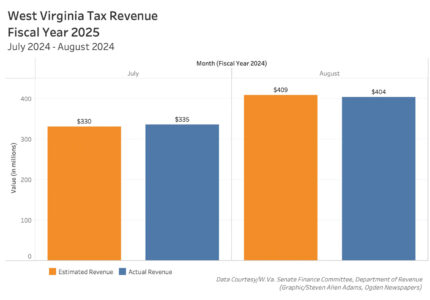
CHARLESTON -- Tax collections in West Virginia came in below projected amounts for the month of August, with year-to-date numbers staying slightly under expectations two months into fiscal year 2025.
According to a monthly report released by the Senate Finance Committee, tax collections for the state's general revenue fund for August came in at $403.8 million, which was 1.3% below the $409 million estimate set by the Department of Revenue and 1.7% below August 2023 collections of $410.8 million.
Year-to-date tax collections for fiscal year 2025 that began in July were $739.2 million, which was 0.03% below the $739.4 million revenue estimate and nearly 0.1% below collections of $745.8 million for the July and August 2023. That puts tax collections for the first two months of the current fiscal year $206,000 below estimates.
Speaking last week during a meeting of the Joint Standing Committee on Finance during August legislative interim meetings at the State Capitol Building, Department of Revenue Secretary Larry Pack said he was not concerned yet with tax revenues staying slightly above and below estimates.
"July was a break-even month. We think August is going to be a break-even month," Pack said. "By the time we get through the first quarter, we'll have a much better idea about where we're going for this fiscal year, but we feel comfortable with the revenue estimates that are in place."
Dragging revenues down in August were collections for the personal income tax and the severance tax on coal and natural gas. Personal income tax collections last month of $151.2 million were 9.3% below the $155.5 million revenue estimate. But personal income tax collections for August were 7.2% higher than the $141 million in August 2023.
Fiscal year-to-date personal income tax collections of $294.1 million are 7.6% below the $307.3 million estimate for July and August, though collections were 2.6% higher than the $286.6 million during the same period in the previous fiscal year.
August severance tax collections of $25.4 million were 33.2% below the $38 million revenue estimate and 38.4% below August 2023 collections of $41.2 million. Fiscal year-to-date severance tax collections of $28.5 million was 32.7% below the $42.2 million estimate and 36.6% below $45 million in collections for both months in the previous fiscal year.
Collections for the consumer sales and use tax and the corporate net income tax came out ahead. August sales tax collections of $166.2 million were 2.5% more than the $162.1 million estimate and 4.5% more than $159 million last August. Sales tax collections for the month provided the state with a $4.1 million surplus.
Fiscal year-to-date sales tax collections of $258.9 million, or 0.8% more than the $256.8 million estimate, for a $2 million surplus.
August corporate net income tax collections of $4.9 million were 28.6% more than the $3.8 million revenue estimate, providing the state with a $1.1 million surplus for the month. But compared to collections one year ago, corporate net income tax revenue was down 41.2% from $8.3 million in August 2023. Fiscal year-to-date corporate net income tax collections of $23.9 million were 65.6% above the $14.4 million revenue estimate for a $9.5 million surplus two months into the new fiscal year.
According to the Senate Finance Committee report, the $739.2 million in total fiscal year-to-date collections does not include the $78 million borrowed from the state's $1.2 billion Rainy Day Fund. State code allows the governor, by executive order, to borrow from the Rainy Day Fund between the start of the new fiscal year and Oct. 31 to pay the state's bills until tax revenue for the new fiscal year comes in. The funds must be repaid within 90 days.
"The practice is in July, we borrow some money from that ... just so we can make our cashflow during the months of July and August," Pack said last week. "We expect that we will pay that back sometime in the middle of September."
The state also borrowed $5.8 million from the $400 million personal income tax reserve fund in August to pay personal income tax refunds last month. Using money from this fund also made it appear that personal income tax collections were higher in August than they actually were.
House Bill 2526, the 2023 law that cut personal income tax rates by 21.25%, created the personal income tax reserve fund in case there was a financial downturn as the state begins slowly phasing out the tax. HB 2526 included a formula and trigger mechanism for continuing to reduce personal income tax rates. The trigger for next year, calculated in August, will further cut personal income tax rates by 4%. Pack said the state will also pay back that $5.8 million to the personal income tax reserve fund in September.
West Virginia ended fiscal year 2024 at the end of June with more than $5.7 billion in tax collections for the general revenue fund, which was 16.9% more than the $4.9 billion estimate set by the state Department of Revenue.
According to the Department of Revenue, the state has $562 million in unappropriated surplus from the end of fiscal year 2024 after expenses and $80 million in unappropriated monies for the current fiscal year.
Gov. Jim Justice has said he will call a special session later this fall to consider supplemental appropriations, a tax rebate for child care and an additional 5% cut in personal income tax rates.
Steven Allen Adams can be reached at sadams@newsandsentinel.com