Crossover Day: West Virginia Senate debates unemployment, women’s rights

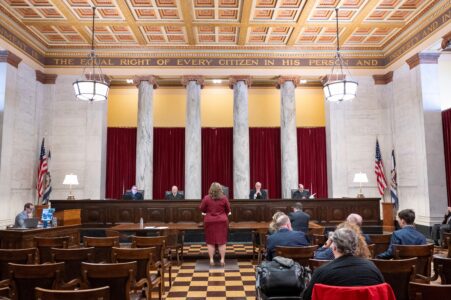
The West Virginia Senate prepares to vote on bills Wednesday for Crossover Day. (Photo courtesy of WV Legislative Photography)
CHARLESTON — The West Virginia Senate spent the day slogging through its Crossover Day agenda Wednesday while also moving quickly on a state budget for the next fiscal year. Lawmakers passed 18 Senate bills beginning Wednesday morning through the early evening, sending those bills to the House of Delegates to meet the Crossover Day deadline. Senators wrapped up their day with a debate over amendments to Senate Bill 601, creating the Senate version of the Women’s Bill of Rights Act. The House version of this bill passed on Feb. 14 but hasn’t been taken up by the Senate. The Senate passed the bill in a 29-2 vote Wednesday night. The Women’s Bill of Rights prohibits the unfair treatment of biological males and females and allows the provision of separate single-sex living facilities, locker rooms, bathrooms, domestic violence shelters and rape crisis centers based on biological sex. SB 601 would define sex-based terms in State Code for “woman,” “girl” and “mother” to refer to biological females except in cases of developmental and genetic anomalies or accidents. The bill requires a person’s biological sex be set at birth, and changes references to “gender” to “sex.” It prohibits use of the term “gender identity,” and other subjective terms. It would change the definition of equal, stating that it does not mean “same” or “identical” when it comes to equality of the sexes. But a debate broke out Wednesday evening between state Sen. Laura Wakim Chapman, R-Ohio, and Senate Judiciary Committee Chairman Charles Trump, R-Morgan. The bill was amended by the committee and later on the floor to make technical corrections. But Chapman attempted to offer an amendment to replace its language with bill language from the House Judiciary Committee. “This amendment simply takes the language of this bill back to the engrossed committee substitute passed by the House of Delegates Judiciary Committee,” Chapman said. “This bill has morphed into different versions in its journey through the two houses. This amendment would most accurately deal with the original intent of the bill.” The issue between Chapman and Trump was over the addition of language to the bill stating that its provisions are subject to federal law. Trump said the language was necessary and not any different than other sections of State Code. “A few senators have talked to me and said we shouldn’t do that. I disagree,” Trump said. “It does not change any of the operative provisions of the bill. The law is the same in both. The point of doing that is to put people on notice that there may be federal law on some of these questions that are addressed by our West Virginia Women’s Bill of Rights.” Chapman and supporters of her amendment said Trump’s federal language was not needed and other language eliminated could cause the entire bill to become impossible to enforce if someone successfully challenges one part of the bill in court. The amendment was adopted in a 19-12 vote. “The language that is inserted in front of every single section…that is language that is unnecessary,” said state Sen. Patricia Rucker, R-Jefferson. “We are, as part of the United States of America, subject to federal regulations. Every single bill and law…is of course subject to them.” “I think the members of the body see that three women will be voting on this amendment and are in favor of the amendment,” said Senate Education Committee Chairwoman Amy Grady, R-Mason. The Senate also passed a bill making substantial changes to the state’s unemployment program. Senate Bill 841 makes changes to state employment taxes and benefits and modifies the calculation for the taxable base wage. The bill passed in a 24-7 vote. SB 841 was amended Wednesday evening to include changes to the amount of weekly unemployment benefits a person could receive. During the first four weeks of unemployment, a person would receive a weekly benefit rate of 70% of the individual’s average weekly wage, dropping by 5% every four weeks. The bill would also reduce the number of total weeks of unemployment from 26 weeks to 24 weeks. The bill would also allow an individual on unemployment to accept a part-time job while collecting unemployment as long as their part-time wages are less than their weekly unemployment benefit. State Sen. Eric Nelson, R-Kanawha, said SB 841 will provide long-term stability for the unemployment trust fund to ensure benefits are available when needed, while also easing the tax burden on employers. “It will restore stability to our unemployment system,” Nelson said. “It will ensure West Virginians who lose a job have a safety net while they get back on their feet, and…it will ensure stability and predictability for West Virginia’s employers.” SB 841 would go into effect in 2025 if passed and signed into law, but state Sen. Mike Caputo, D-Marion, remains concerned about the timing of the bill, given that two major employers in the state announced layoffs last week affecting more than 1,500 jobs. “We can’t get this wrong,” Caputo said. “I’m not saying this is a bad idea. It could be a great idea…I would encourage all parties to get to the table and work this out. I’ll go with them to that table…but I don’t think this should be done in the 11th hour.” The Senate also suspended the constitutional rule requiring bills be read three separate days and passed Senate Bill 200, the budget bill, Wednesday night in a 31-0. The budget and supplemental appropriations bills are not subject to the Crossover Day deadline in order to pass. SB 200 sets the general revenue budget for fiscal year 2025 beginning on July 1. Not counting appropriated federal revenue funds, tax revenue derived from the general revenue budget accounts for more than 27% of the $19..2 billion in total estimated revenue for fiscal year 2025 according to the state Department of Revenue. During his eighth and final State of the State address on the first day of the 2024 legislative session Jan. 10, Gov. Jim Justice presented lawmakers the budget bill for the next fiscal year.. Justice kept the FY25 general revenue budget flat at $5.265 billion, which was a 7.8% increase — or $381 million — from the $4.884 billion fiscal year 2024 budget that went into effect last July. The Senate’s version of the general revenue budget is $4.934 billion, which is a 1% increase from the current fiscal year but a 6.3% decrease from Justice’s recommended budget of $5.265 billion. Justice’s budget proposal included a 5% pay raise for state employees, teachers and school service personnel, and state troopers, costing $123 million. Justice also proposed $49.7 million in additional tax cuts, including the elimination of income taxes on Social Security benefits for single filers earning $50,000 or more, and joint filers earning more than $100,000. The House has passed bills for the teacher/staff/trooper pay raise and a three-year phase out for those remaining Social Security recipients, but the Senate has not and it was not said whether their version of the budget includes pay raises for other state employees. The House and Senate finance committees will have to reconcile their issues in order to pass a budget by the final day of the session on Saturday, March 9. Steven Allen Adams can be reached at sadams@newsandsentinel.comLocal News

Teen of the Week: Belpre’s Dugan leads by example

Supreme Court: Five-way race to complete late justice’s term
Memorial Health System announces Marietta Physicians Care Express move
MARIETTA — Memorial Health System will soon relocate its Physicians Care Express in Marietta from 800 Pike St. to ...

Memorial Health Foundation fashion show raises over $142K

Students learn about AI at AI Hackathon