
West Virginia House completes work on budget, passes multiple bills
Trending
CHARLESTON -- With one day left in the 2023 legislative session, the West Virginia House of Delegates approved a compromise with the state Senate on the budget for next fiscal year and passed more than 50 bills Friday.
The House began the day Friday morning by concurring with a Senate amendment to House Bill 2024, the budget bill, passing it in a 91-6 vote and sending it to the desk of Gov. Jim Justice.
HB 2024 is a compromise between the House and Senate on the budget bill, setting the general revenue budget for fiscal year 2024 beginning July 1. The compromise sets the budget at $4.875 billion.
The compromise is $9.2 million more than the budget bill Justice submitted on the first day of the legislative session Jan. 11. It is also 10% more than SB 150, the Senate version of the budget passed nearly two weeks ago, and 5% more than the version of HB 2024 passed by the House last week, which was a $4.642 billion budget.
The budget bill includes a $2,300 pay raise for executive branch public employees who are paid from the general revenue budget, as well as a bill for a $2,300 pay raise for teachers, school service personnel and West Virginia State Police troopers/staff.
Justice had proposed his fourth 5% average pay raise for public employees, but lawmakers changed that to a straight $2,300.
"We did not have at that time the $2,300 pay raise that we passed earlier this week, so when we sat down to talk about this compromise, the $2,300 got added back in," said House Finance Committee Chairman Vernon Criss, R-Wood.
HB 2024 includes new expenses from bills passed by the House and Senate over the last 59 days, including Senate Bill 268, the Public Employees Insurance Agency solvency bill; House Bill 3035, funding teacher aids and interventionists for early elementary school grades; and HB 2002, increasing funding to the Department of Health and Human Resources for support for new families.
HB 2024 also includes more than $1.165 billion in one-time funding placed in the surplus section in the back of the budget to be paid out if the state ends the current fiscal year with surplus tax revenue. The state is expected to end the fiscal year in June with more than $1.7 billion, with more than $1 billion collected in surplus tax revenue as of the end of February.
Senate Bill 220, the Industrial Hemp Development Act, passed the House in a 92-4 vote. The House also approved a related bill. SB 546, adding and removing certain compounds from the controlled substance list, passed the House in a 91-3 vote.
SB 220 creates the Hemp-derived Cannabinoid Regulation Act, regulating the selling of naturally-produced hemp products, such as Delta 8 and Delta 10 products, and outlaws synthetic hemp products. SB 220 would define Kratom and Kratom products also derived from hemp.
Senate Bill 677, clarifying the role and responsibilities of the State Resiliency Officer, passed the House 91-0.
The House version of the bill requires the State Resiliency Officer to submit a new Flood Resiliency Plan by June 30, 2024, and then every two years thereafter. It bumps up the qualifications to be the State Resiliency Officer.
The bill gives the State Resiliency Officer authority over the West Virginia Disaster Recovery Fund to provide funding for disaster recovery for people, local governments, emergency services, and local organizations with priority for low-income geographic areas or low-income households.
The bill creates the West Virginia Flood Resiliency Trust Fund to encourage local governments to work on flood protection and prevention projects. The fund would prioritize low-income geographic areas and prioritize nature-based solutions, using the local environment and features to protect against flood damage.
A change made by the House to the bill requires that 6% of future Community Development Block Grant - Disaster Recovery Funds received by the state as a result of a flood disaster be deposited in the Flood Resiliency Trust Fund. The Senate version required 25% of CDBG-DR funds be placed in the fund.
The House wasn't completely without drama Friday. During the morning floor session, Del. Adam Vance, R-Wyoming, objected several times to having bills explained by committee chairs, requiring the bills to be read in full.
The House also voted down Senate Bill 508, clarifying reporting and disclosure requirements for grassroots lobbying expenditures, in a 35-61 vote. The bill would have lifted the dollar amount that triggers reporting to the Secretary of State's Office from $500 to $5,000 during a three-month period, and from $200 to $1,000 spent during a one-month period.
A few hours later, a motion was made to reconsider the vote on SB 508, with the bill passing 49-41 with 10 members absent from the chamber. Members of the Democratic minority accused the Republican majority of succumbing to pressure to reconsider the vote.
"This is the Friday night special that I'm so tired of in this chamber," said House Minority Whip Shawn Fluharty, D-Ohio. "If you reconsider that, (the voters) will be reconsidering you next election. There will be plenty of $5,000 being spent every three months advocating against you."
And debate over Senate Bill 523, clarifying the purpose and use of the Economic Development Project Fund managed by the state Economic Development Authority, pitted a small group of vocal Republicans against the remainder or the majority. The bill passed 83-14, with 13 of the nay votes coming from Republicans who oppose the use of tax dollars to leverage and entice new economic development projects to the state.
SB 523 set an annual cap of $300 million that the EDA can finance for high impact development projects, $250 million for traditional loans, and $50 million for business retention loans unless additional funding is appropriated by the Legislature. A failed amendment offered by Del. Todd Kirby, R-Raleigh, would have capped the dollar amount for high impact development projects and traditional loans at $50 million.
Kirby accused supporters of the bill for engaging in Soviet Union-style central planning and misusing tax dollars that could be better used in communities across the state for needs.
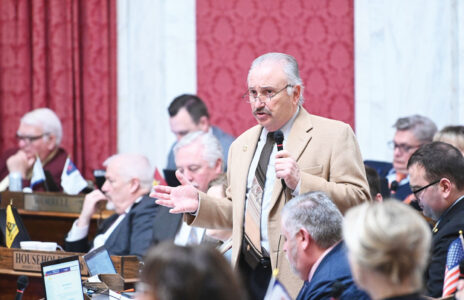
"There is nothing in here about central planning," Kirby said, holding up a copy of the West Virginia Republican Party platform. "There's nothing in here about deals made behind closed doors and giving the members 48 hours to vote on secret deals proprietary in nature. I didn't change. You all changed, and I think the voters are taking not of it.
Opponents of Kirby's amendment accused the supporters of trying to tie the hands of the Department of Economic Development for recruiting new businesses. According to the Department of Commerce, 29 new businesses said they were coming to the state in between January 2022 and Wednesday, representing a total investment of $6.19 billion and creating more than 3,300 jobs.
"Our economic team has been nothing but successful," said House Finance Committee Vice Chairman John Hardy, R-Berkeley. "They have brought billions upon billions of economic growth to the state. The best social program we can offer anybody in this state is a good job."
Several of the Senate bills passed by the House Friday will need to head back to the Senate to concur with changes the House made to the bills. The 60-day legislative session ends at midnight Saturday.
Steven Allen Adams can be reached at sadams@newsandsentinel.com