
Bill limiting substance use treatment beds in West Virginia counties completes legislative action
Trending
CHARLESTON -- All five of Wood County's representatives in the West Virginia House of Delegates approved changes to a bill to limit the number of substance use disorder treatment beds in a single county.
The House concurred Wednesday with changes made by the state Senate to House Bill 3337, prohibiting additional drug and alcohol treatment facilities and services in certain counties, passing the bill again in a 77-19 vote. The bill has completed legislative action and now heads to the desk of Gov. Jim Justice.
HB 3337 would prohibit the granting of certificates of need to expand the number of licensed substance abuse treatment beds in any county which already has greater than 250 licensed beds.
The House version of the bill grandfathered in newly constructed facilities or buildings being converted into facilities prior to Feb. 1, but Senate changes to the bill removed the grandfather provision, putting a hard cap on substance use disorder treatment beds.
"This change will prohibit the creation of drug and alcohol treatment beds once a county has obtained 250 beds," Delegate Laura Kimble, R-Harrison.
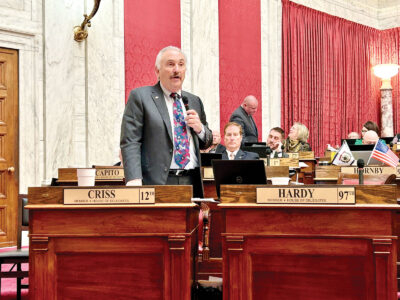
All the Republican delegates representing Wood County -- Bill Anderson, Vernon Criss, Bob Fehrenbacher, Scot Heckert and Dave Foggin -- voted in favor of the bill.
According to previous testimony, Wood County alone had 281 substance use treatment beds in 2021, accounting for 25% of the licensed treatment beds in the state, with 206 of those beds in Parkersburg city limits. Parkersburg City Council voted 8-1 in 2021 for a one-year moratorium on additional facilities from setting up within city limits, then adopted additional zoning restrictions.
"There's plenty of room for people that want them in counties where they have them and they want more," Heckert said. "We have 281 and I promise you it will turn your town into the walking dead."
"We indeed probably brought this upon ourselves, but we are ill suited to support the people who come to Wood County for support," Fehrenbacher said. "There are 39 other counties in West Virginia that have zero (beds). Wood County also has a disproportionate share of treatment, but we are well underserved, and we lack capabilities for the next step. People can come to Wood County and these beds, but after four weeks when they are discharged there are very few ongoing recovery beds and support facilities."
House Health and Human Resources Committee Vice Chairwoman Heather Tully, R-Nicholas, said Wood County has received more than $4.4 million through the Department of Health and Human Resources' Ryan Brown Addiction Prevention and Recovery Fund for expansion of treatment beds in the county, taking money away from other counties that might have liked to expand treatment beds.
"The people sought out those beds. They wanted the treatment beds, and they got them," Tully said. "I'm sorry they have come forth with some problems, but I also don't think that this amendment … does any good for the people there providing services to those clients."
House Health Committee Minority Vice Chairman Mike Pushkin, D-Kanawha, said the majority was dealing with a problem of too many beds in Wood County by putting an arbitrary cap on all 55 counties.
"We're going to try to correct this by coming up with another magic number and applying it to everybody else's county here," Pushkin said. "I'm for people getting help and I'm for treatment beds and recovery homes, but I'm also for having it based on need and not based on some artificial number that somebody made up."
House Bill 2459, passed in 2017, exempted the construction and development of drug and alcohol treatment facilities from certificate of need laws. These facilities also are exempt from municipal zoning laws due to substance abuse being classified as a disability. Substance abuse treatment facilities in West Virginia are regulated through the Department of Health and Human Resources' Office of Health Facility Licensure & Certification.
Another bill passed in 2017 and sponsored by former Wood County Delegate John Kelly, House Bill 2428, empowered DHHR to ensure beds for alcohol and drug substance use are made available in locations throughout the state deemed the highest priority.
"With the overpopulation of beds in Wood County came a problem. We are recruiting people from Idaho, from Montana, from Colorado. They're coming to West Virginia. They're coming to Parkersburg. They're coming to take those beds," Criss said. "They got into the program, quit the program, and became problems for the City of Parkersburg and the County of Wood for all the social issues we have."
"This is a way to help fix it," Criss said. "You may be right, we may be back here later on to fix it again. This is like a two-tripper to Lowes, guys. We've got to try again here to fix the problems."
Steven Allen Adams can be reached at sadams@newsandsentinel.com.