
Certificate of need updates, correctional emergency resolution pass West Virginia House
Trending
CHARLESTON -- A bill carving out several exemptions for healthcare providers and hospitals in the West Virginia certificate of need law and a resolution ringing the alarm bells about the correctional officer vacancy crisis were among bills and resolutions passed by the House of Delegates Thursday.
The House passed 18 bills on reading agenda as it completes its legislative agenda before the end of the 2023 legislative session at midnight Saturday.
One of the bills the House passed Thursday was Senate Bill 613 relating generally to certificates of need. The bill passed 75-20.
SB 613 would exempt hospitals from seeking certificates of need for new hospital services, defined as inpatient services. These services would include preventative, diagnostic, treatment, or rehabilitative services provided in various departments on a hospital's campus.
SB 613 would make needing a certificate of need to offer ambulatory services unnecessary as long as the service fell within the 250-yard requirement to be part of a hospital's campus. It would allow private medical practices with at least seven locations to acquire an MRI machine without going through the certificate of need process.
The bill would also remove requirements for birthing centers to receive a certificate of need similar to House Bill 2789 that passed the House on Feb. 7. West Virginia has only one birthing center, the Family Care Health Center's OB/GYN and Birth Center on Charleston's West Side.
"This is going to help our constituents," said House Health and Human Resources Committee Vice Chairwoman Amy Summers, R-Taylor. "This is going to allow them to have more access to care. It's also potentially going to lower costs because these entities are going to have to start competing against each other. So, if I can offer a service at my hospital for x-amount of dollars and I'm trying to draw people over, I will try to offer it at a lower cost. So, I think this helps everyone."
Certificate of need requirements were put into State Code in 1977, making West Virginia one of 35 states with a certificate of need process. Certificate of need rules are designed to help control health care costs and prohibit duplicative or unneeded medical services in communities.
Several attempts have been made over the years to chip away at certificate of need requirements, including an attempt last year to eliminate West Virginia's certificate of need law altogether. According to the National Conference of State Legislatures, 12 states have repealed certificate of need laws.
The bill had trouble making it to the finish line though. SB 613 was up for passage March 4, but House leadership kept making motions to postpone action on the bill for five days straight before finally taking up the bill Thursday.
The bill also fell under controversy after it was revealed that Senate Majority Leader Tom Takubo, R-Kanawha, is in talks to sell his practice, Pulmonary Associates of Charleston, to Thomas Memorial Hospital in South Charleston for $2.8 million. The offices of Pulmonary Associates is 176 yards from Thomas Memorial Hospital, meaning Thomas would not need to seek a certificate of need to purchase the practice.
"When you think about what practice would be within that 250 yards of a hospital and hypothetically is in the process of being sold to said hospital and now removing it from the certificate of need, I think once the books are closed on this session and the dots are connected, we know of a few individuals that this would definitely help," said House Health Committee Minority Vice Chairman Mike Pushkin, D-Kanawha.
The House also adopted 15 resolutions Thursday, including House Concurrent Resolution 78, proclaiming the extension of a state of emergency in the state's correctional institutions.
Gov. Jim Justice has declared a state of emergency twice over the past six years for the prisons and regional jails due to severe staffing shortages, including in August 2022. The West Virginia National Guard was ordered to assist with staffing needs until this August.
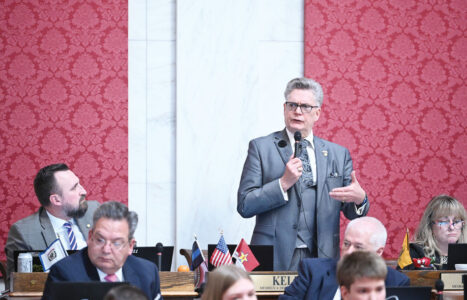
"I applaud the governor for putting us there. I applaud him for knowing that we had a real problem in our jails and our prisons, and I'm thankful that he called the Guard up to try to fill the gap," said House Jails and Prisons Committee Chairman David Kelly, R-Tyler. "But ladies and gentlemen, we all know in this house that to continue this indefinitely is not sustainable."
According to figures cited by Kelly from the Division of Corrections and Rehabilitation, there are 1,042 vacancies in the state's correctional system which consists of 11 prisons, 10 regional jails, 10 juvenile centers and three work-release sites. The vacancy rate is 27% overall, but when looking only at correctional officers, the overall vacancy rate is 33%.
Individual facilities have much higher vacancy rates. According to Kelly, Potomac Highlands Regional Jail has a 76% officer vacancy rate. The Vicki Douglas Juvenile Center in Martinsburg has a 60% officer vacancy rate.
"We have a problem and I respect the National Guard and what they're doing, but we can't sustain that indefinitely," Kelly said. "We have to find a way forward."
Bills to increase the pay for correctional officers, provide correctional officers with a one-time bonus, and provide locality pay to recruit and retain correctional officers in parts of the state facing severe shortages of officers remain stuck in the finance committees of the House and the state Senate. Kelly urged Justice to address the correctional officer pay issue.
"I applaud the governor, but I'd like to applaud him one more time," Kelly said. "It's out of our hands to do legislation, but it would be great if the governor would come up with a pathway forward to give these officers a raise so we can get new officers hired very quickly."
Steven Allen Adams can be reached at sadams@newsandsentinel.com.