
West Virginia House passes bill to provide resources to new families
Trending
CHARLESTON -- West Virginia lawmakers received criticism with the passage last summer of a near-total ban on abortion for not passing bills to help young mothers or to encourage adoption, but a bill passed by the House of Delegates Thursday was aimed at those criticisms.
The House passed a committee substitute for House Bill 2002, relating to providing support for families, Thursday in a 88-8 vote. The bill now heads to the state Senate.
HB 2002 would increase the nonfamily adoption personal income tax credit from $4,000 per non-family child under 18 to $5,000. If the taxpayer chooses, the credit can be spread out over a three-year period. According to a fiscal note from the Department of Revenue, the increased tax credit could return $1 million annually to eligible taxpayers.
"We have a unique opportunity to help adoptive families by raising their one-time tax credit," said House Finance Committee Chairman Vernon Criss, R-Wood. "This goes a long way to helping the expenses involved through adoption."
The bill requires that beginning on July 1, children adopted by West Virginia residents would be eligible for early intervention services provided by the Department of Health and Human Resources. These services could include Right from the Start, Drug Free Moms and Babies and Birth to Three.
HB 2002 also requires DHHR's Bureau for Public Health to establish the West Virginia Mothers and Babies Pregnancy Support Program that would provide funding to eligible "pregnancy help organizations" that provide support to pregnant women, but don't offer abortion services or referrals. These include crisis pregnancy centers, maternity homes, adoption agencies and social services agencies that provide material support and other assistance to pregnant women.
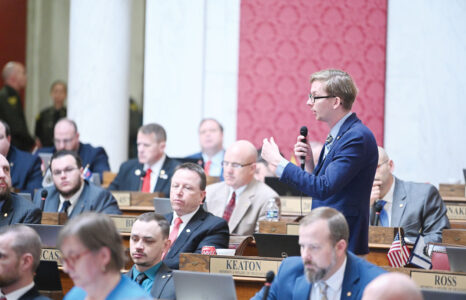
"These organizations do a lot of tremendous work," Delegate Riley Keaton, R-Roane, said. "These organizations and people, out of the kindness of their hearts, provide loving and life-affirming care in big ways and small to women in often-times difficult circumstances."
According to a fiscal note from DHHR, the cost to implement the requirements of HB 2002 upon full implementation would be $1.6 million annually.
The bill is related to legislation passed by the Legislature late last summer limiting abortion access in West Virginia. The Legislature passed House Bill 302, clarifying West Virginia's abortion laws, in September after beginning a special session on tax reform at the end of July.
HB 302 banned all abortions in the state unless a licensed medical professional's reasonable judgment calls for an abortion, such as cases of a non-medically viable fetus, ectopic pregnancies or medical emergencies. The bill only allows abortions to be performed by medical or osteopathic doctors at licensed medical facilities, such as hospitals.
Abortions in the instances of sexual assault or incest are exempt from the abortion ban up to eight weeks of gestation for adults and 14 weeks for minors. A report of sexual assault of incest must be made to law enforcement and provided to the licensed medical professional performing the abortion. For minors, the patients would also be required to obtain medical treatment for sexual assault or incest.
Members of the House Democratic Caucus expressed support for some parts of the bill, such as the adoption tax credits and increasing access to services offered by DHHR. But some members of the minority caucus were not pleased with possibly providing tax dollars to crisis pregnancy centers, which are often accused of providing little in the way of actual health care for mothers.
"The reason I'm going to vote no on this bill is sending taxpayer dollars to these pregnancy-help organizations, organizations that are not required to uphold medical privacy rules, medical ethics rules, organizations that are agenda-driven," said Delegate Evan Hansen, D-Monongalia. "The agenda is to prevent abortions from occurring in the State of West Virginia."
"We're giving funding of no amount in the budget to medical or non-medical religious or non-religious help centers," said Delegate Danielle Walker, D-Monongalia. "There's a lot of questions that can't be answered and there's a lot of assumptions. I don't want to make an assumption. I want to make sure, with the infant mortality and morbidity rate we have in West Virginia, that the person carrying the baby will have the best outcomes."
Steven Allen Adams can be reached at sadams@newsandsentinel.com.