
Justice asks West Virginia Senate to give tax cut plan full consideration
Senate GOP leaders say they will not be rushed
Trending
CHARLESTON -- Gov. Jim Justice called on the West Virginia Senate to pass his personal income tax cut bill in a briefing Monday, but Senate Republican leaders said they are working on an amendment to that bill and will not be rushed.
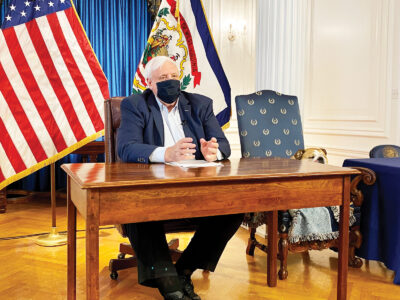
Justice and Department of Revenue Cabinet Secretary Dave Hardy held what they called a "town hall" Monday afternoon from the Governor's Reception Room at the State Capitol Building, Unlike past briefings, this one was open to both the public and the press.
Justice, wearing a face mask after announcing last week that he tested positive for COVID-19 for a second time in 12 months, urged the Senate to take up House Bill 2526, cutting the personal income tax by 50% over a three-year period plus putting an additional $700 million to cover any financial issues that could affect the cuts.
Justice proposed HB 2526 during his State of the State address Jan. 11 on the first day of the 2023 legislative session. The bill was introduced on his behalf the next day and quickly approved by the House Finance Committee. The bill passed the full House 95-2 last Wednesday. The bill has been referred to the Senate Finance Committee.
"We've got to stay real positive and hope like crazy the Senate is going to get us the other third of the way there, and then we'll go on down the road and celebrate all kinds of goodness that's going to happen to this great state," Justice said. "I want to be super-positive that we're going to celebrate with the Senate and everybody is going to run across the finish line."
HB 2526 would phase in a 50% personal income tax cut, with a 30% cut retroactive to January of this year, returning $163 million to taxpayers. Another 10% cut would kick in beginning in July, returning $1.085 billion to taxpayers, with the final 10% cut kicking in July 2024, returning $1.229 billion to taxpayers when fully implemented.
But speaking after Justice's town hall, Senate President Craig Blair said the state Senate would not be pressured or rushed into passing HB 2526. Senate staff are still reviewing the bill and its possible financial implications.
"I feel like, having whatever this was down there, was an attempt to put pressure on the Senate, and the Senate is not going to be pressured," Blair, R-Berkeley, said. "That's not even going to happen."
Blair said the Senate is working on an amendment to provide a 50% personal income tax in year one, though he said it remains to be seen when it would kick in. Blair said they are seeking an independent review of their plan to ensure it is financially feasible.
"He keeps using the term '50%,' but it's not 50%. Let's be honest," Blair, R-Berkeley, said. "The plan that they have put forward at this point in time, we're busy working on perfecting it so it works long-term so the next governor and the next Legislature hopefully will not have to come back and manage these mistakes that could be made."
Justice said he has worked closely with the House, including former House Finance Committee Chairman and now House Majority Leader Eric Householder, R-Berkeley, over the last several months to develop HB 2526. The Department of Revenue has also vetted the plan and believes the state can afford it.
"From Thanksgiving until probably the State of the State, these people worked … day after day after day to find what could be the fallacies to make sure we were on rock-solid ground," Justice said. "There is no question in my mind … that there is nothing more important than this moment right now. This moment is our moment to put that stake in the sand and say 'by God, we're West Virginia.'"
Yet, except for one meeting since the start of the legislative session, Blair said the Senate has not been involved with the crafting of HB 2526 or consulted one way or another.
"The Senate was not included in any discussion on this plan," Blair said. "Months of work have went into it, apparently, so they say."
Blair and Senate Finance Committee Chairman Eric Tarr, R-Putnam, also said they were concerned with HB 2526 in light of the Governor's proposed budget for fiscal year 2024 and new spending created by bills being passed by the Legislature as well as supplemental appropriations using remaining excess tax collections.
Justice proposed a general revenue budget for fiscal year 2024 beginning in July of $4.884 billion, 5% more than the $4.645 billion general revenue budget for the fiscal year 2023 passed by lawmakers last year. State revenue officials estimate the state could bring in $6.1 billion in the next fiscal year, providing the state $1.216 billion in surplus tax collections.
The state ended the fiscal year with $1.3 billion in surplus tax collections for the general revenue fund, with $793 million of that going to one-time expenditures at the back of the current fiscal year budget and $150 million in a supplemental appropriation last year. According to a list of proposed supplemental appropriations for this year using available surplus tax dollars, that would leave $200,745 left in surplus funds from the prior fiscal year.
"We need to prioritize spending on this, because you can't do it all. The list is extensive," Blair said. "Are these things being calculated into this equation? We believe they are not … This governor has went and spent all but $200,000 of the current excess revenues for this fiscal year and wants us to treat them as supplements with zero collaboration with the Senate."
In an article Monday, Jared Walczak, vice president of state projects for the Tax Foundation in Washington D.C., also raised some red flags about the Governor's approach to HB 2526, calling the plan "aggressive" but supporting the idea of cutting the personal income tax. He said both chambers and the Governor should be able to come together and hammer out a compromise.
"There should be room for the two chambers and the governor to negotiate to provide taxpayers with significant income tax relief while addressing legitimate concerns about pace," Walczak wrote. "Michigan and West Virginia. That's the entire list of states with an individual income tax that didn't adopt any significant tax relief in the past two years. Surely West Virginia policymakers can find a way forward to get themselves off that short and unenviable list."
Steven Allen Adams can be reached at sadams@newsandsentinel.com.