
Deskins: Population loss, lack of adult workers remain issues in West Virginia

John Deskins, director of WVU’s Bureau of Business and Economic Research, speaks with state Sen. Chandler Swope, R-Mercer, following Deskins’ economic presentation Wednesday. (Photo by Steven Allen Adams)
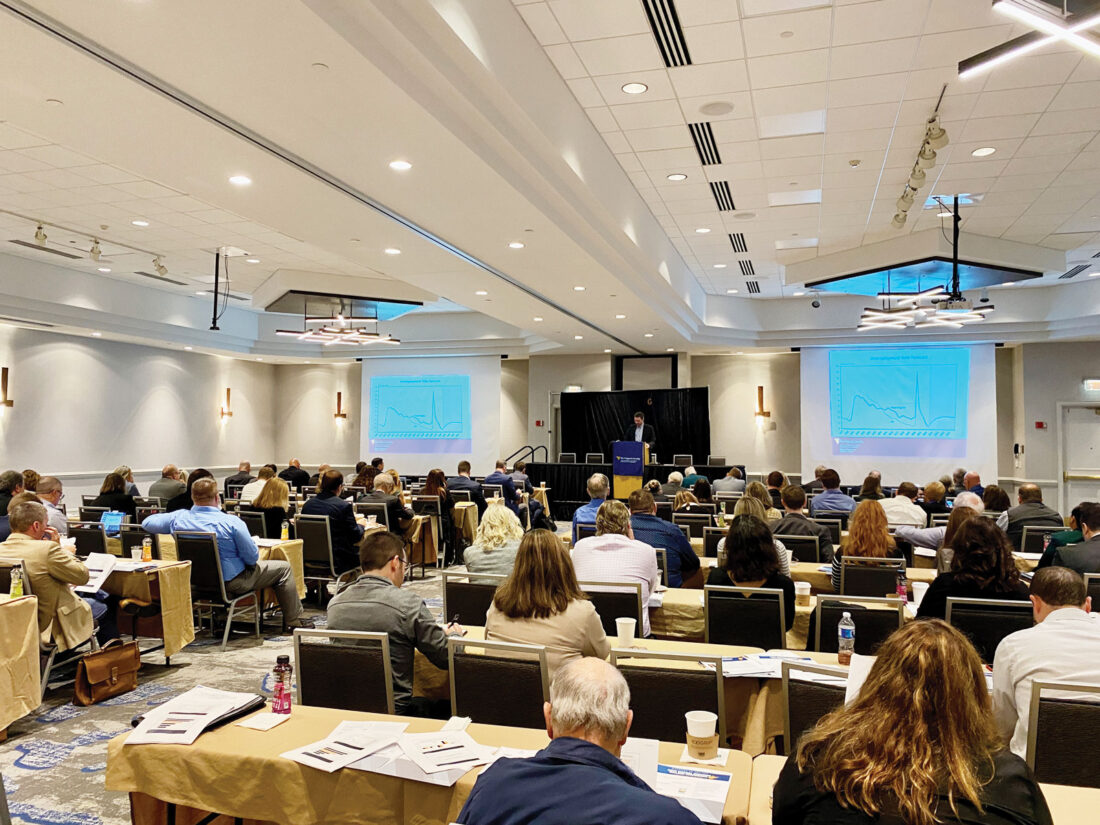
WVU held its annual Economic Outlook Conference at the Embassy Suites in Charleston on Wednesday. (Photo by Steven Allen Adams)
John Deskins, director of WVU’s Bureau of Business and Economic Research, speaks with state Sen. Chandler Swope, R-Mercer, following Deskins’ economic presentation Wednesday. (Photo by Steven Allen Adams)
WVU held its annual Economic Outlook Conference at the Embassy Suites in Charleston on Wednesday. (Photo by Steven Allen Adams)
Trending
CHARLESTON -- No matter what kind of tax relief West Virginia elected officials consider, one of West Virginia University's top economists said that it won't be enough to solve the state's declining population and labor force participation issues.
WVU held its annual Economic Outlook Conference at the Embassy Suites in Charleston on Wednesday. Attendees heard from a number of presenters, including John Deskins, director of the Bureau of Business and Economic Research at WVU's John Chambers College of Business and Economics.
Gov. Jim Justice and Republicans in the West Virginia Legislature are butting heads over the best way to cut taxes: either by cutting the personal income tax by 10% and phasing it out over time; or eliminating certain tangible personal property taxes, such as machinery/equipment, inventory and vehicles.
Deskins declined to express support for the governor's personal income tax cut plan or the Senate's plan to eliminate tangible personal property taxes despite being supportive in the past of eliminating machinery/equipment and inventory taxes. Instead, Deskins focused on West Virginia's long-term problems of declining population and shortage of working age residents in the state's labor pool.
"I wish that our biggest problem was that we had a really bad tax system," Deskins said. "Wouldn't that be an awesome problem to have? Because if we had a bad tax system, we could just fix it. I'm not saying our tax system is perfect and I'm not saying I'm for this policy change or that policy change … but this is a problem that even if we do make policy changes today that we need to make, it would still take five to 10 years to see real differences in these statistics."
According to data from the Bureau of Business and Economic Research, population growth in West Virginia will continue to decrease between 2022 and 2027, though the rate of decrease will be slower than between 2011 and 2021.
Broken down by age, the state population is only expected to grow between 2022-2027 for those age 65 and older, though that growth is expected to slow from 2011-2021 levels. Population growth for those ages 0-17 and 45-64 between 2022-2027 will continue to shrink faster than between 2011-2021, though the rate of population growth for those ages 18-44 between 2022-2027 will slow to less than -0% after approaching -1% growth between 2011-2021.
West Virginia's aging population and flight of young adults to other states is a huge driver of West Virginia's labor force participation rate which remains one of the worst in the nation. But Deskins said there are other factors at play.
"You must have asked: is this problem of labor force participation driven by the fact that we have an older population? Obviously if you have more people who have retired, that reduces labor force participation," Deskins said. "Of course, the answer is 'of course.' Of course, having an older population is clearly an important driver of our low rate of labor force participation … but it is so much deeper than that."
According to the Federal Reserve Bank of St. Louis, West Virginia's seasonally adjusted labor force participation rate for August was 55.2%, up slightly from 54.8%. The state seasonally adjusted unemployment is also rising from a record low of 3.5% in May to 3.9% in August.
Deskins pointed to the U.S. Census data from 2021 showing that the state's labor force participation rate for residents between the ages of 25 and 54 was 74.1%, dead last in the U.S. and behind the national average of 82.5%. According to data presented by Deskins, the lack of working age adults in the state labor force is due to the state having the worst higher education degree attainment rate of all 50 states, the highest mortality rate, and the highest drug overdose rate.
The keys to improving workforce participation in West Virginia in the future according to Deskins include improving access to two-year community and technical college education and apprenticeship programs for high-paying in-demand jobs, improving health outcomes for West Virginians, and more resources for substance abuse treatment and rehabilitation.
Deskins also said the state needs more positive shocks in economic development, citing the example of North Carolina-based green steel manufacturer Nucor building an electric arc furnace in Mason County. When finished, the plant will provide high-paying jobs to West Virginians, but it will also need workers to move to West Virginia, driving population growth and other economic opportunities.
"Nucor is so big and has so much potential that we don't have the people in West Virginia to man that plant," Deskins said. "It's going to encourage people to move in from other states. That is the perfect example of the kind of positive shock that we have engineered to create positive momentum instead of negative momentum."
Deskins said state economic development officials should focus their business recruitment efforts on industries, such as chemicals, plastics, aerospace, rare earth minerals and carbon products, industrial diversification and entrepreneurship and outdoor recreation and tourism.
Steven Allen Adams can be reached at sadams@newsandsentinel.com.