
Capito, McKinley discuss broadband at Oglebay Park
Trending
WHEELING -- Oglebay Park consists of more than 2,000 acres of trees, hills and valleys -- a terrain that's not ideal for bringing quality broadband internet access to the resort's cottages, according to park officials.
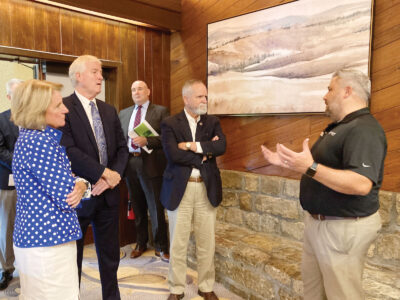
U.S. Sen. Shelley Moore Capito, R-W.Va., on Wednesday hosted a broadband summit at Oglebay Park's Wilson Lodge to discuss the technological challenges and internet needs of those doing business in the 21st century.
Among those attending were U.S. Rep. David B. McKinley, R-W.Va.; Doug Kinkoph, associate administrator of the National Telecommunications and Information Administration's (NTIA) Office of Internet Connectivity and Growth; internet providers and other government officials.
"Broadband, I think, is the most essential item in West Virginia and one of the needs," Capito said. "We have been falling short. I started a capital funding plan (for broadband) in the Senate to meet this challenge.
"I know that there are spots up here in the Northern Panhandle that are still unserved and underserved. We have a great opportunity through the infrastructure bill -- every house and every business should be served."
The Infrastructure Investment and Jobs Act passed last year not only provides money to expand broadband to underserved areas, but also requires accurate mapping to show where these areas are, Capito explained.
"We know that here at Wilson Lodge and Oglebay, a lot of the cottages have good internet connection -- others, not so much," she said. "We need all those served to serve the community and the traveling visitor."
Tom McCroskey, director of information technology for Oglebay Park, said West Virginia overall doesn't have enough access to high-quality internet connectivity, though federal legislation to increase funding for broadband expansion nationwide has helped.
Oglebay Park has adequate broadband function from Comcast at Wilson Lodge and its main structures, he explained. The park, meanwhile, works with Citynet to provide broadband to the outlying cottages.
Recent upgrades within Wilson Lodge allow conference attendees there to do a conference call from the Glessner Auditorium with someone in Los Angeles, explained Robert Peckenpaugh, president and CEO of the Wheeling Park Commission.
But an attendee may also bring their family to the conference, with the group staying in one of the cottages on the property. If three family members all want to watch different Netflix shows at the same time, a problem can occur, he acknowledged.
Oglebay now is looking to find a way to take over the task of providing internet service to the cottages, McCroskey explained. This would permit park employees to address any issues immediately, and not have to wait for any third-party assistance.
"If we've got it under our control, we can take care of it right then and there," he continued.
People wanting to hold conferences, meetings and weddings at the resort often first ask about the availability of broadband, and Oglebay must meet those expectations, McCroskey said.
He isn't certain yet what the cost will be to achieve the needed internet access at the cabins.
McKinley explained funding for broadband expansion nationwide was an important component of the federal infrastructure bill passed by Congress, but it hasn't had the traction it should have because most of the communities in need of high-quality internet are in rural areas.
"Congress is controlled by larger cities," McKinley continued. "Los Angeles has 22 congressmen, Chicago has 15 congressmen and New York (City) has 16. Montana has one.
"When you're trying to get an allocation for appropriation money for broadband, New York and Los Angeles are going to say, 'We've got ours. We don't need to spend the money.'"
Smaller states must form coalitions so they can speak out on what they need, he added.
"And we need to have this (broadband)," McKinley said. "If we are going to play on a level playing field economically with businesses and healthcare, we have to be on the same plate. We have to make sure more money goes to rural America rather than just the big cities.
"The big cities already have broadband. We don't have it in West Virginia -- not to the extent we should have it," he added.