
Mid-Ohio Valley officials talk broadband with McKinley
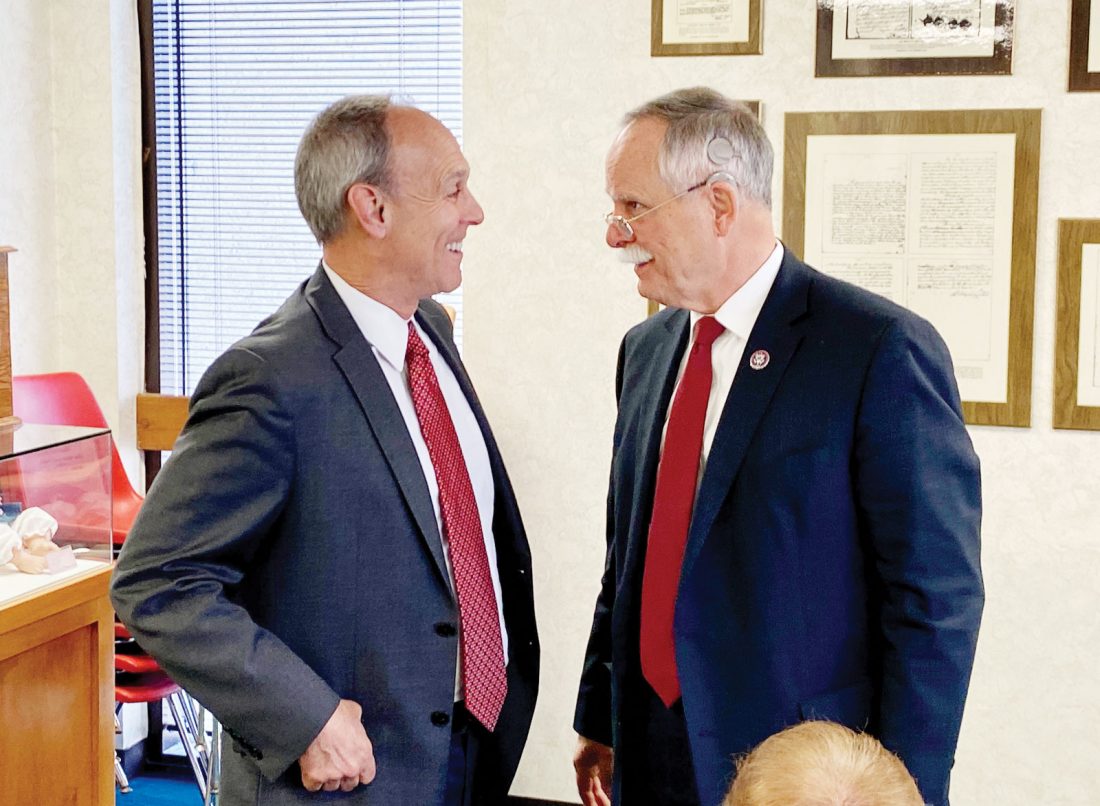
U.S. Rep. David McKinley, right, and state Department of Economic Development Secretary Mitch Carmichael, left, discussed West Virginia’s progress in broadband expansion Friday. (Photo by Steven Allen Adams)
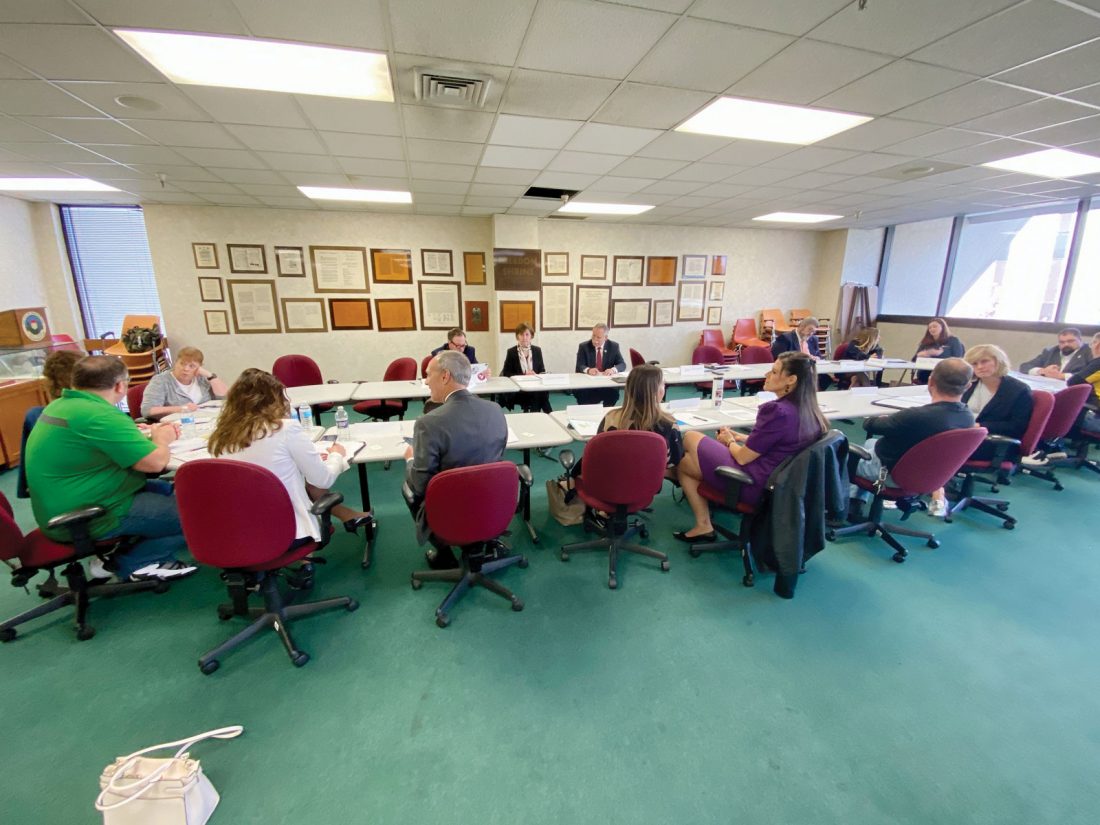
U.S. Rep. David McKinley, R-W.Va., met with West Virginia and local officials and industry representatives Friday about broadband needs. (Photo by Steven Allen Adams)
U.S. Rep. David McKinley, right, and state Department of Economic Development Secretary Mitch Carmichael, left, discussed West Virginia’s progress in broadband expansion Friday. (Photo by Steven Allen Adams)
U.S. Rep. David McKinley, R-W.Va., met with West Virginia and local officials and industry representatives Friday about broadband needs. (Photo by Steven Allen Adams)
Trending
PARKERSBURG -- With West Virginia handling more than $1 billion in broadband funds through multiple federal sources, 1st District Congressman David McKinley met Friday in Parkersburg with state and local leaders and telecommunications industry officials to learn how to best use these dollars.
McKinley, R-W.Va., held a roundtable discussion of broadband issues at the Parkersburg Municipal Building on Friday morning with Parkersburg Mayor Tom Joyce, Wood County Commission President Blair Couch and representatives of the county commissions of Ritchie, Doddridge, Tyler, and Gilmer counties.
Also in attendance were representatives of the Wood County Economic Development Office, the United States Telecom Association, the Wireless Industry Network, and the Cellular Telecommunications and Internet Association. McKinley said it was important to hear from a diverse group of people with multiple perspectives on broadband deployment.
"Broadband is so complex that I thought maybe it was good we all sit down and let's hear from some of the movers and shakers that are involved in this," McKinley said.
West Virginia is set to receive $138 million for broadband expansion through President Joe Biden's American Rescue Plan. The state can also use part of the $1.355 billion it's receiving through the American Rescue Plan for infrastructure projects, such as broadband expansion. Counties and cities are receiving a combined $679 million through the Biden plan that can also be used for broadband projects.
Including previous funding through the U.S. Department of Agriculture, the Appalachian Regional Commission, and the Federal Communications Commission's Connect America and Rural Digital Opportunity Fund program, West Virginia is sitting on more than $1 billion dollars for broadband expansion.
The latest set of funding comes from the Infrastructure Investment and Jobs Act passed by Congress in November. West Virginia will receive at least $100 million for broadband expansion through the hard infrastructure bill.
"What we have in this infrastructure (bill) is a lot of positive stuff that is going to happen in West Virginia, but the one thing we hear so much about in this infrastructure bill is broadband," McKinley said. "What we hear constantly is we don't have good internet, we don't have good broadband, bad cell phone service. I could go on and on about how bad it is in West Virginia. As we talk to people and economic development folks, that's the first thing they talk about. How are we going to attract businesses in here if we don't have good service?"
Mitch Carmichael, cabinet secretary for the Department of Economic Development, said programs put in place by the Office of Broadband last year have put West Virginia ahead of other states when it comes to broadband infrastructure planning. Efforts include more reliable broadband maps to show where unserved areas of the state are, expanding existing network line extensions, rapid wireless deployment projects, major broadband infrastructure investments, public/private partnerships, and local government/matching broadband funding incentives.
"We are moving forward. The infrastructure bill has helped an incredible amount to provide funding for needed infrastructure," Carmichael said. "One of the good markers we are achieving is on the digital divide, the lack of broadband availability … all of our efforts and programs we have put into place are solely about reaching the unserved."
Carmichael said the Office of Broadband has identified about 300,000 homes and addresses in West Virginia that do not have adequate broadband services as defined by the FCC as at least 25 Mbps download speeds and 3 Mbps uploads speeds. Carmichael believes the programs his department has put in place will quickly expand broadband and spur competition among internet services providers.
"We believe that competition is the right way, incentivizing new investment and all of those aspects are the best way," Carmichael said. "We'd rather have a customer say 'if I don't like my broadband service, fine. I'll sign up with competitor B' as opposed to saying 'let's go to the Legislature and put a regulation in place that you have to do this or do that.' We resist that."
Couch said one of the biggest frustrations for the county is getting both reliable broadband and wireless service into rural areas. Attempts for the county to build its own tower have been fruitless because no carriers want to participate.
"We have a dual problem in certain areas of Wood County, specifically like the community of Belleville," Couch said. "It doesn't have broadband, so people and kids drive all the way up to Lubeck to sit in the church parking lot to go to their online class. They don't have cell coverage … we've investigated putting towers in, but we can't get a provider to co-locate."
Loyd Linger, WIN's West Virginia representative and president of Buckhannon-based Innovative Tower Solutions, said finding workers to climb poles and towers to install broadband is also a problem. Nationwide, Linger said there are 15,000 openings for workers with the average cost to train new workers at $10,000 per week.
"Funding for training is what kills us," Linger said. "If I train a guy and 10 months down the road he gets stolen away, I'm out $10,000 and they get another trained employee."
Linger said the infrastructure bill should include a grant program to offset training costs. He also said a training program for new telecommunications workers with local community and technical colleges would be helpful. Carmichael said he would talk to the West Virginia Community and Technical College System about implementing such a training program.
Steven Allen Adams can be reached at sadams@newsandsentinel.com