West Virginia House passes multiple bills in marathon floor session
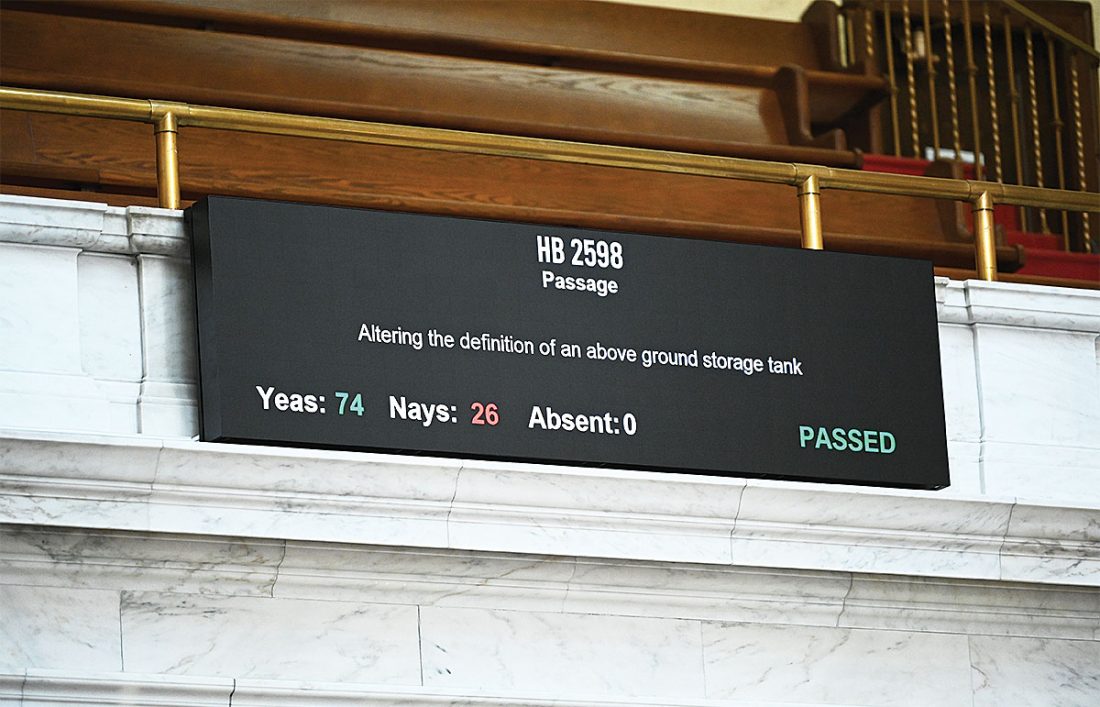
A digital board in the House of Delegates chamber announces the vote totals on the aboveground storage tank bill. (Photo courtesy of WV Legislative Photography)
CHARLESTON — The West Virginia House of Delegates met for nearly four hours Wednesday, debating multiple bills dealing with classification of gig workers, COVID-19 liability protections, and exempting some aboveground storage tanks from certain regulations.
The House started its Wednesday floor session at 11 a.m. and adjourned at 2:41 p.m. in one of its lengthiest floor debates as the 2021 legislative session hits the halfway mark today. The House passed four House bills and five state Senate bills.
Much of Wednesday’s debates centered around three bills: Senate Bill 272, creating the West Virginia Employment Law Worker Classification Act; Senate Bill 277, creating the COVID-19 Jobs Protection Act; and House Bill 2598, altering the definition of an aboveground storage tank.
SB 272 changes how state code defines independent contractors and creates criteria for determining the difference between contract employees and hourly or salary employees. The bill passed 77-23 along party lines
A report released last year by the Legislative Auditor’s Office found that WorkForce West Virginia received a “fail” rating from the U.S. Department of Labor due to being unable to detect misclassified employees. Businesses sometimes try to get around tax issues by labeling some workers as independent contractors.
“Worker misclassification not only has a negative impact on the individual employees but can potentially cost the State millions of dollars in lost revenue from income taxes, worker’s compensation premiums, and unemployment insurance taxes, among others,” the audit report concluded. “… Employers have a financial incentive to misclassify their workers as independent contractors. In fact, employers in West Virginia can save in excess of $6,000 per employee misclassified as a result of not being assessed payroll taxes for those workers.”
Independent contractors have become more common in recent years due to companies — such as Uber, Lyft, Grubhub, and others — entering into what is called the gig economy. These are jobs people enter into in addition to a regular job to earn extra money.
“This is an entrepreneurship bill,” said House Judiciary Committee Chairman Moore Capito, R-Kanawha. “One thing I think this bill really does is it addresses the concerns of both sides of that contract. We’ve heard … about modernizing this sort of contractual relationship, proving predictability.”
Gig workers often have no health endurance, benefits, or workers compensation. Del. Kayla Young, D-Kanawha, has worked as a contract worker and a small business owner. She said the bill doesn’t address the issues raised in the Legislative Auditor’s report, which could create federal penalties for small business owners in the state.
“Freedom is incredibly important, and labor is great, and I love the intent of this bill … but my big issue with this bill is that it totally disregards the fact we still have to follow the federal guidelines,” Young said. “This bill doesn’t help the federal problems. We still have to fix that.”
The House passed SB 277 in a 76-24 vote. Del. Todd Longanacre, R-Greenbrier, was the lone Republican to vote with the Democratic minority. The bill, introduced on behalf of Gov. Jim Justice, provides certain civil immunity from liability claims for injuries and damages resulting in severe coronavirus illnesses and death. The state Senate must approve changes to both SB 272 and 277 before they head to the governor’s desk.
The House also passed HB 2598 in a 74-26 votes, with delegates Jason Barrett, R-Berkeley, and Moore Capito voting with the Democratic caucus against the bill.
The bill would exempt aboveground storage tanks holding 210 barrels or less, about 8,820 gallons, and used for brine water or other fluids produced for use by the oil and natural gas industry from the Aboveground Storage Tank Act. The bill would exempt the tanks from inspection under the AST Act located in zones of critical concern protecting public surface water supplies, groundwater supply sources, and streams in watersheds.
The bill was introduced by House Energy and Manufacturing Committee Vice Chairman John Kelly, R-Wood. He said the bill exempts only 887 aboveground storage tanks — 2 percent of the more than 44,000 aboveground storage tanks in the state.
“We’re asking to change the inspections on brine tanks,” Kelly said. “We’re not asking for anything that we felt is dangerous. I demand clean water, I demand clean air, I demand regulations, but I demand fair regulations. That’s all we’re asking for.”
Del. Evan Hansen, D-Monongalia, spoke out against the bill. The owner of an environmental and economic development consulting firm that developed the source water protection plan for Morgantown, Hansen said HB 2598 weakens clean drinking water protections.
“It’s working,” Hansen said. “What I am asking on behalf of water drinkers in your district and across West Virginia, let’s not increase the risk of contamination.”
Steven Allen Adams can be reached at sadams@newsandsentinel.com
Local News
Beverly-Waterford community leaders recognized at 22nd annual chamber banquet
Former U.S. Rep. McKinley dies at 79
Start Westward debate stalls legislation at Marietta Council meeting
Democrats seek recusal from justice
CHARLESTON – The state Democratic Party is now calling for the chief justice of the West Virginia Intermediate ...
Guild casting ‘1776’ for 250th