
W.Va. House committees target medical abortion
‘Reversal’ claims not supported by medical community
Trending
CHARLESTON -- A West Virginia House of Delegates committee approved a bill Tuesday recommending a way to stop a medical abortion to patients, though the medical community does not back the procedure.
Health and Human Resources Committee recommended House Bill 2982, the Second Chances at Life Act, for passage in a 19-5 vote. The bill's next stop is the House Judiciary Committee.
The Second Chance at Life Act would require women seeking a medical abortion to be informed about ways to reverse or stop the abortion process when mifepristone is used.
Medical abortions utilize two pills, with doctors dispensing mifepristone first and then misoprostol. HB 2982 would require the patient -- before undergoing the medical abortion -- to be informed that it may be possible to stop the abortion and inform the patient where to find additional information.
The bill also requires the doctor to give the patient specific discharge instructions which give more information about stopping the medical abortion and direct the patient to a toll-free number and abortionpillreversal.com, a website maintained by anti-abortion pregnancy resource network Heartbeat International.
The American College of Obstetricians and Gynecologists (ACOG) does not endorse abortion reversal treatments and neither does the U.S. Food and Drug Administration. Supporters of reversal treatments cite a 2012 case where six women took part in only the first of the two-drug medical abortion process, taking varied doses of progesterone, with four of the women maintaining their pregnancies. ACOG noted that the study was not properly done and had no control groups.
A double-blind placebo study in 2019 by the University of California-Davis found that three out of 12 women who took part in the study taking mifepristone and progesterone experienced severe bleeding issues. Two of women with bleeding issues had a placebo for their second pill instead of progesterone. Researchers halted the study after the three bleeding incidents.
"Facts are important, especially when discussing the health of women and the American public. Claims regarding abortion 'reversal' treatment are not based on science and do not meet clinical standards," ACOG said on their website. "Unfounded legislative mandates represent dangerous political interference and compromise patient care and safety."
HB 2982 does not mention progesterone and an amendment removed all references to "reversal," but the website the bill would refer patients to does.
"My amendment to this bill actually is trying to take that out, from moving it from a reversal to just stop," said Del. Ken Reed, R-Berkeley, a pharmacist. "So, the bill is basically an informed consent bill with the normal doctor-patient relationships involved, including the side effects, risks with any procedure, benefit-versus-risk ratio that I'm sure all these physicians are going to go through."
Democratic members of the committee moved to have the bill lay over until the committee's Thursday meeting to allow time for testimony for medical professionals, but the motion was voted down.
"We want to get expert testimony. We don't have that here today," said Del. Jim Barach, D-Kanawha, a meteorologist. "As a scientist myself, I always look to the scientists and the experts to give me guidance on what to do on something like this."
"Mainly I have an issue with … telling doctors how to practice," said Del. Mike Pushkin, D-Kanawha. "There's nothing in law that would prohibit a doctor from recommending this now. I think that this really gets in the way of a doctor-patient relationship. I have an issue with that, and also have an issue with us treating women like they can't make this decision for themselves."
The committee also heard no testimony from women, though women members of the committee made sure to express their thoughts on the bill.
"You're not supposed to practice medicine without a license, and these laws are practicing medicine without a license as written," said Del. Barbara Fleischauer, D-Monongalia. "The current laws are flawed because they do not address potential risk of so-called abortion reversal procedures."
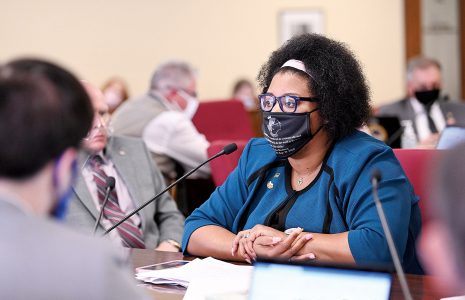
"I was one of those patients who elected to have an abortion, and I don't feel that we should disrespect anyone's decision because it is freedom and choice," said Del. Danielle Walker, D-Monongalia. "Can we just be a little bit more respectful to the people who actually have the female genitalia?"