
West Virginia University students report on Parkersburg area’s economy
-
- Photo by Brett Dunlap Niko Stilianoudakis, an economics/math major at West Virginia University, is part of a three-student team who wrote an Economic Outlook Report for the Parkersburg area.
-

- Photo by Brett Dunlap C. Clinton Gabbert, a graduate student in Forest Resource Management at West Virginia University, talks Wednesday about the impact the natural gas industry will have on the state and this region.
-

- Photo by Brett Dunlap Hannah Lopez, an environmental science and natural resource economics major at West Virginia University, speaks Wednesday about local demographics in the potential for business development in this area.
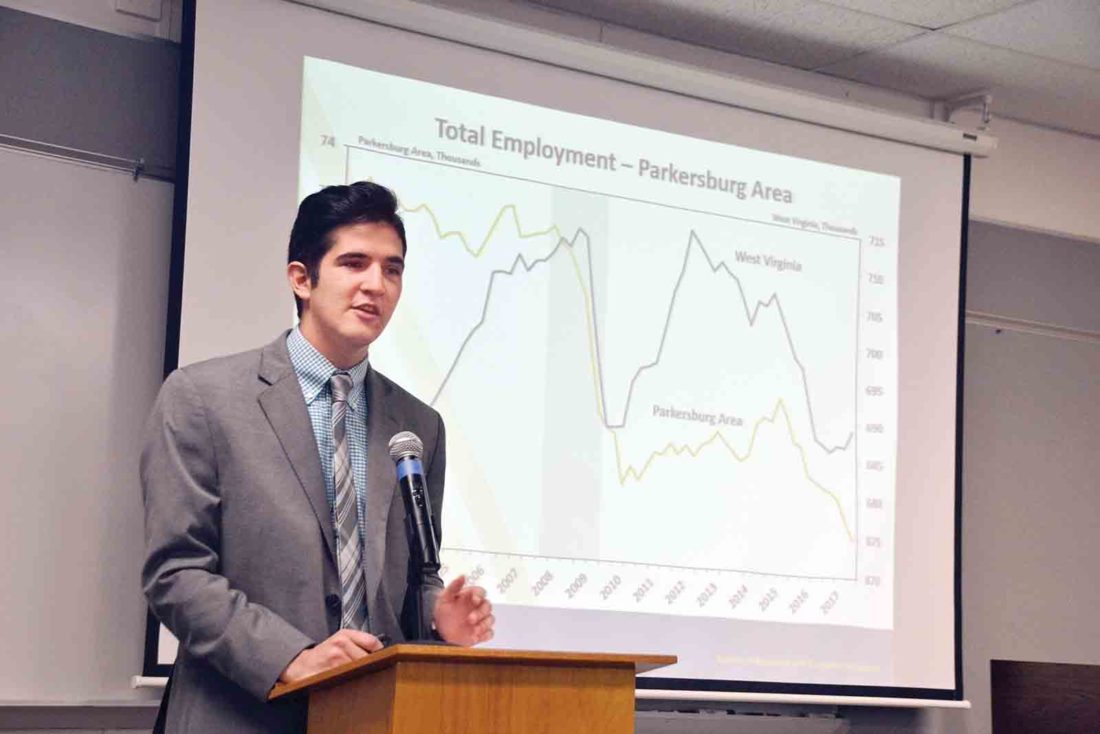
Photo by Brett Dunlap Niko Stilianoudakis, an economics/math major at West Virginia University, is part of a three-student team who wrote an Economic Outlook Report for the Parkersburg area.
PARKERSBURG — The Mid-Ohio Valley region is poised for economic development through the natural gas industry, but this area and the rest of the state still needs to diversify its economy to create opportunities for wide-range economic growth, according to a report.
John Deskins, director of business and economic research and an associate professor at West Virginia University, and three of his students who have been looking at economic trends of the Mid-Ohio Valley as part of a statewide study presented a report Wednesday at West Virginia University at Parkersburg to area leaders.
More than 60 local business, educational, community, development leaders and others heard the report detailing a regional economic study and forecast report for the Mid-Ohio Valley, which includes Wood, Wirt, Pleasants and Ritchie counties in West Virginia and Washington County, Ohio.
“The Parkersburg area economy has experienced dramatic turmoil in recent years,” the report said. “The region managed to avoid the initial economic downturn that plagued several parts of the state between 2012 and 2015, as payrolls (in this area) increased by 1,500 over this time frame.
“Since then, however, the Parkersburg area economy has struggled significantly, with employers shedding over 3,000 jobs since the beginning of 2015,” the report states.

Photo by Brett Dunlap C. Clinton Gabbert, a graduate student in Forest Resource Management at West Virginia University, talks Wednesday about the impact the natural gas industry will have on the state and this region.
Recently, even as overall hiring activity has picked up within the state with growth in the construction and energy sectors, the Parkersburg area has not.
“…the Parkersburg area has yet to emerge from its slump as large job losses in a few of the region’s service-providing sectors have hampered its ability to recover,” the report stated.
Deskins said the report was a way for the students to work on real-world issues and present them to the communities that want to know this information.
Niko Stilianoudakis, an economics/math major, said West Virginia’s economy has seen a significant downturn in the last five years with a loss of 26,000 jobs from 2012 to 2017, with a significant number coming from the coal industry.
“We are constantly asked, ‘When is this recession going to end?”‘ he said. “It looks like it has finally bottomed out and we are improving.”

Photo by Brett Dunlap Hannah Lopez, an environmental science and natural resource economics major at West Virginia University, speaks Wednesday about local demographics in the potential for business development in this area.
The state added 4,500 jobs in 2017.
“However, we still need to keep that sense of urgency to grow faster, because we are not growing as fast as we would like,” Stilianoudakis said.
In the Parkersburg area, Wood and Washington counties have the largest employment numbers.
“When West Virginia has good times, Parkersburg does not necessarily have bad times, but they don’t have great times either,” Stilianoudakis said. “They remain constant. But when West Virginia has bad times, Parkersburg also has bad times and loses jobs.”
Around 2,500 jobs were lost in 2015 from the natural gas industry and retail sectors locally, he said.
However, the state’s economy is growing again through energy development, primarily natural gas development. Coal has suffered with declines from 2008 (160 million Short Tons of coal) to now (just over 80 million Short Tons of coal) produced which was due to the environmental regulatory climate, the natural gas boom and a decline in international demand, he said.
Hannah Lopez, an environmental science and natural resource economics major, talked about income growth and composition which is happening slowly in the region.
“We would like to see a faster pace of growth,” she said.
Nationally, around 63 percent of adults want to work. In West Virginia, it is 53 percent.
“West Virginia is dead last in all 50 states,” she said. “This gap is a major concern.”
Some people do not look for work because of their education level and job skills are lacking, they have health issues and drug abuse as overdose deaths in West Virginia are high, Lopez said.
“People addicted to drugs don’t bother looking for work, because they know they can’t pass a drug test,” Lopez said. “Fixing this gap is important, because we want West Virginia to be prosperous and on track with the national average.”
The state needs to address the drug epidemic as well as improve education, labor force participation and the health of the population, she said.
“We want to make our state attractive to potential businesses and bring more opportunities to West Virginia,” Lopez said. “Potential businesses will not locate here unless they are confident they can find potential workers here and that means gaining workers who are educated, healthy and drug free.
“As the overall population gets older, we have fewer and fewer people ready to work.”
C. Clinton Gabbert, a graduate student in Forest Resource Management, talked about the potential impacts the natural gas industry will have statewide and in the Mid-Ohio Valley. The industry has seen an 11 percent increase in wages since 2010. “We believe there is still potential for major downstream gas activities to be located in this region,” he said. “This would bring many skilled and high paying petrochemical jobs to the region and it would be truly transformative for the region.”
All of the presenters talked about the need for the state, as a whole, to diversify the state’s economy.
Entrepreneurs are the ones who can say what works and what doesn’t work in developing businesses, Gabbert said.
“This should be considered in every economic development decision being made in a region,” he said. “What can we do to create an environment more conducive to small business.”
They can indicate what industries can grow and thrive in a region, Gabbert said.
Although large business development gets a lot of attention, small business has a place in the discussion as well, he said.
“An argument can be made that 10 small companies, providing 70 jobs each, is just as good, if not better, as one large company providing 700 jobs,” Gabbert said. “With smaller businesses providing those jobs, you have a more diverse economy.
“Small businesses are just as important as larger businesses.”
In Parkersburg, employment in natural resource development, construction and professional and business services is expected to see growth, the presenters said.
They also talked about the importance of technical college training for many of the jobs that could be coming to the region in the coming years as opposed to a four-year college degree. They said the expansion of Hino in the area has potential to bring in other connected businesses.
“It involves a whole bunch of different pieces,” Deskins said. “We have to have a good regulatory environment, we have to have a good tax environment, good infrastructure and we need to make sure we can provide the businesses with healthy, educated and drug-free workers.”
Local News
Redacted term sheet provides additional details on new proposed loan for Justice-owned Greenbrier
CHARLESTON – Attorneys for U.S. Sen. Jim Justice and his family provided a redacted term sheet for a possible new ...
Lambert hired as new Randolph superintendent of schools
ELKINS - Dr. Derek Lambert said his first priority as the new Randolph County superintendent of schools will be to ...
1 dead, 1 injured in ATV crash
BARLOW TWP. – One man is dead and a woman was hospitalized after an ATV crash on Memorial Day. Carl B. Hall II, ...

Gov. Morrisey announces America 250 merchandise, calls for bells to be rung on July 4
West Virginia Supreme Court rules in favor of firefighters in lawsuit against Parkersburg
PARKERSBURG – The West Virginia Supreme Court of Appeals ruled this week that the City of Parkersburg was wrong ...
Sisters Health Foundation announces $531K in grants
PARKERSBURG – Forty-three nonprofit organizations in the Mid-Ohio Valley have been awarded grant funding in ...