
Wooton to serve as chief justice of West Virginia Supreme Court of Appeals for 2025
Bunn will serve as chief justice in 2026
Trending
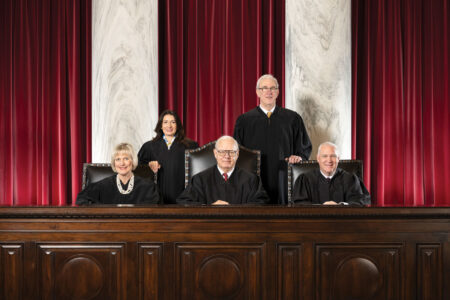
CHARLESTON -- The position of chief justice of the West Virginia Supreme Court of Appeals will rotate to Justice William "Bill" Wooton for 2025, followed by Justice C. Haley Bunn in 2026.
According to a press release Monday afternoon, Wooton was designated to serve as chief justice next year by his colleagues on the high court. He succeeds Justice Tim Armstead, who served as chief justice for 2024.
"I am honored to be selected by my colleagues to serve as chief justice in the coming year and look forward to this opportunity to lead our judicial branch," Wooton said. "West Virginia is unique in that we rotate our chief justice every year. I believe this helps strengthen our Court by allowing each of the five justices to share in the administrative work of the judicial branch while bringing our own individual perspectives to its leadership."
Wooton was first elected to the Supreme Court in 2020 for a 12-year term after an unsuccessful attempt in 2016. Wooton served in the state Senate from 1990 to 2000 and served several terms in the House of Delegates, most recently between 2008 and 2010. During his time in the state Senate, Wooton served as the chairman of the Senate Judiciary Committee, helping to write and pass many laws found in today's criminal and civil code.
Armstead is wrapping up his second stint as chief justice after serving in that role in 2020. Armstead and former justice Evan Jenkins, a former state senator and 3rd District congressman, were appointed by Gov. Jim Justice in August 2018 to fill vacancies left behind by former justices Menis Ketchum and Robin Davis, respectively. Both won special elections later that year to fill the remainder of those terms. Armstead won election to a full 12-year term in 2020.
"I'm proud of what we accomplished in 2024, including our efforts to make magistrate court records more accessible by launching an online search portal as well as the work we began toward clarifying the role of guardians ad litem in abuse and neglect matters," Armstead said. "I know Justice Wooton will continue our Court's commitment to transparency and accountability while also strengthening the public's trust in our court system."
Bunn, who will be chief justice in 2026, just won election in May to a full 12-year term on the Supreme Court in an uncontested race. Justice appointed Bunn to the high court in 2022 to fill the remainder of Jenkins' term after he resigned to return to the private sector. Bunn, a native of Oceana, W.Va., was an attorney for the Steptoe and Johnson law firm and a former assistant U.S. Attorney.
"I'm grateful for this opportunity to serve the people of our state and look forward to working with Chief Justice Wooton throughout 2025," Bunn said.
Also joining the Supreme Court next year is former Republican Morgan County state senator Charles Trump, who resigned earlier this month to prepare for his new role. Trump, who also was unopposed on the May ballot, succeeds Justice John Hutchison. Trump, a former member of the House of Delegates and state Senate, served as Senate Judiciary Committee Chairman since 2015.
Hutchison declined to run for election for a full term after being appointed by Justice to the Supreme Court in 2018 to fill the seat vacated by former Justice Allen Loughry, who was convicted in federal court of 11 counts, including mail fraud, wire fraud, witness tampering and making false statements to investigators. Hutchison won election to the Supreme Court in a special election in 2020 to serve the remainder of Loughry's 12-year term.
One of the first goals for the Supreme Court in 2025 will be revising and updating the West Virginia Code of Judicial Conduct, which governs the actions of justices, judges, magistrates, attorneys, and other court officers. The court appointed an eight-member advisory committee to make recommendations to the Supreme Court on Code of Judicial Conduct changes.
Retired West Virginia University College of Law professor Forrest "Jack" Bowman will serve as chairman of the advisory committee. Other members will include Senior Status Judge Alan D. Moats; Circuit Judge Anita Harold Ashley; Family Court Judge Heather A. Wood; Magistrate Judge Riley H. Barb; Del. Brandon Steele, R-Raleigh; state Senator-elect Joey Garcia, D-Marion; and advisory member David Sachar, the director for the Center for Judicial Ethics at the National Center for State Courts.
The Code of Judicial Conduct first went into effect in 1993 and was last revised in 2015. The committee has a deadline of Dec. 31, 2025, to submit proposed recommendations to the Code of Judicial Conduct. The committee can also review changes to the Rules of Judicial Disciplinary Procedure if changes are necessary.
"It has been some time since the Court conducted a comprehensive review of the Code, and it is a good practice to proactively review it in order to ensure the integrity and effectiveness of the judiciary," Armstead said. "This advisory panel will work over the next year to identify best practices, taking into consideration national trends, and bring those recommendations to the public and the Court for consideration."
Steven Allen Adams can be reached at sadams@newsandsentinel.com