House Republican majority unveils Jobs First Opportunity Everywhere agenda
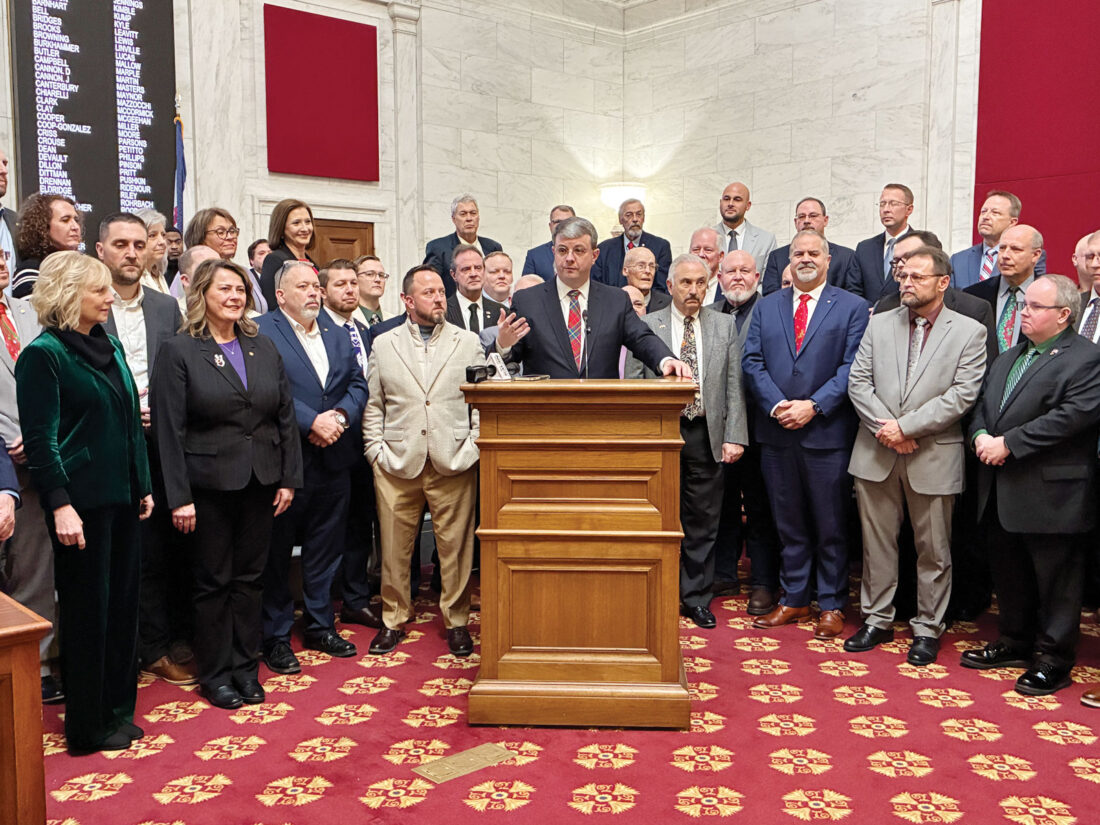
House Speaker Roger Hanshaw, joined by members of the House Republican caucus, unveiled their Jobs First - Opportunity Everywhere legislative agenda during a press conference Tuesday. (Photo by Steven Allen Adams)
CHARLESTON – House Speaker Roger Hanshaw and the Republican supermajority of the West Virginia House of Delegates laid out their Christmas list for the next legislative session in January focused on job creation and economic development. During a press conference in the House of Delegates chamber Tuesday afternoon, Hanshaw was joined by nearly 50 members of the 91-member Republican House majority in unveiling the “Jobs First – Opportunity Everywhere” legislative agenda, which will include a number of bills to be introduced during the 2026 regular session of the West Virginia Legislature beginning Wednesday, Jan. 14. “This is the time of year that we all reflect on what the past year has meant to us and look forward to what the future year holds for us to begin to make plans for,” said Hanshaw, R-Clay. “We know that for many West Virginians who follow the machinations of our government…this is the time of year when our members are home and people begin asking, ‘What are you going to do,'” Hanshaw continued. “We want to take time today before we disperse and end our regular December interim meetings and talk to you today about the economic development and job creation agenda that our majority caucus will be introducing and considering when we convene here next month in January.” Hanshaw said the Jobs First – Opportunity Everywhere agenda was developed after surveying members of the House Republican caucus, a majority of which said their priorities included creating job opportunities, creating economic growth, and empowering West Virginians to make economic development decisions, about their future, for themselves and their families. “We have the perspective of every West Virginian represented here in the front of the room today. And that means that opinions are different,” Hanshaw said. “But what unifies those opinions, what unifies all those communities, is the reality that putting jobs first works everywhere, whatever the issue, it’s most effectively solved in an environment that has a robust jobs economy, that has a robust jobs program that puts people to work in good paying jobs and gives them the capacity to make decisions for themselves and their families.” Jobs First – Opportunity Everywhere is broken down to three core pillars: workforce-ready education, a job-creating business climate, and responsible economic growth. Pillar one will include legislation to raise teacher and school service personnel salaries; a bill to expand an existing program to support local businesses that invest in upskilling their employees; legislation designed to expand co-op programs and provide more hands-on learning opportunities for 16- to 18-year-old students; and an aviation technician, maintenance repair, and operation program. The final platform in pillar one involves legislation to create a program to link lawmakers and state government more closely to the state’s higher education system to fund research to solve West Virginia-specific problems. “We’ll introduce a bill modeled on a very successful program out of North Carolina that we’ll call the West Virginia Collaboratory Program that will more closely tie our Legislature and state government to higher education in West Virginia to fund research that’s important to public policy here in West Virginia so that we can get West Virginia solutions to problems that face West Virginia,” Hanshaw said. Pillar two will involve legislation to update State Code to allow existing chemical and manufacturing sector employers to use additional materials in order to create new job growth opportunities; legislation to provide workers with “modern solutions for retirement flexibility;” and a bill to create certainty and finality regarding the timelines for Public Service Commission decisions. Other items in pillar two include an act designed to give the Division of Economic Development the flexibility to award tax credits and incentives to a broader range of industries; a plan to create more hangar space at local and regional airports; an initiative to ensure that integrated resource plans filed by electric utilities take advantage of advanced transmission technology; and the creation of “Team West Virginia,” modeled after the Jobs Ohio program. “The concept of Team West Virginia is to take economic development into a direction that removes all political considerations from it and makes economic development decisions based on what’s best for West Virginians,” Hanshaw said. “Because we want to double down on the belief that creating a job, putting men and women in good paying jobs, is priority number one for the government.” Pillar three includes legislation aimed at addressing the state’s housing shortage by making it easier and more affordable to build new housing; a commitment to “double down” on the existing site readiness program to address the lack of suitable sites for development; and an initiative to address the housing shortage by ensuring that housing developers do not incur “disadvantageous tax treatment” in West Virginia. Other items in pillar three include a program aimed at legacy family businesses to provide capital and financing arrangements for these companies to expand operations, and a renewed focus on the existing industrial access road program to ensure that developed sites are fully accessible for construction and operations. “West Virginians said they wanted to put economic growth in job creation at the center of public policy debate here in West Virginia. And that still shapes our policy landscape today,” Hanshaw said. Watching Tuesday’s announcement were several members of the nine-member House Democratic caucus, including House Minority Leader Pro Tempore Kayla Young, D-Kanawha. While she said more details would be needed for her caucus, Young said many of the items Hanshaw listed could gain Democratic support next year. “Some of it’s a little vague…but overall, I’m excited about it personally,” Young said. “A lot of the bills are priorities that members of my caucus have had for several years, and we’ve just never seen bills move for one reason or another. I’m personally excited to see the majority focus on something other than social issues for the first time in a very long time.” Young said the House Democratic caucus would need to further review the potential legislation to ensure that the bills are not harmful to taxpayers and will not raise rates on electricity customers. “I want to make sure that any money that we’re giving to any public funds that we’re spending, we have transparency and accountability always,” Young said. “I want to make sure that we aren’t doing anything on the backs of ratepayers that don’t benefit them directly as we already have very high utility rates. But overall, I think it’s something that we’re going to be able to work on in a bipartisan manner. “We’re excited to put jobs first,” Young added. Steven Allen Adams can be reached at sadams@newsandsentinel.comLocal News
House Republican majority unveils Jobs First Opportunity Everywhere agenda

Suspect in Monday shooting identified, charged with attempted murder

Zelenskyy meets in London with European allies on the US peace plan and Ukrainian security

Bullets in Luigi Mangione’s bag convinced police that he was UnitedHealthcare CEO killing suspect

Connect the Watts: AI, data centers may be crucial for coal-fired power, natural gas production